
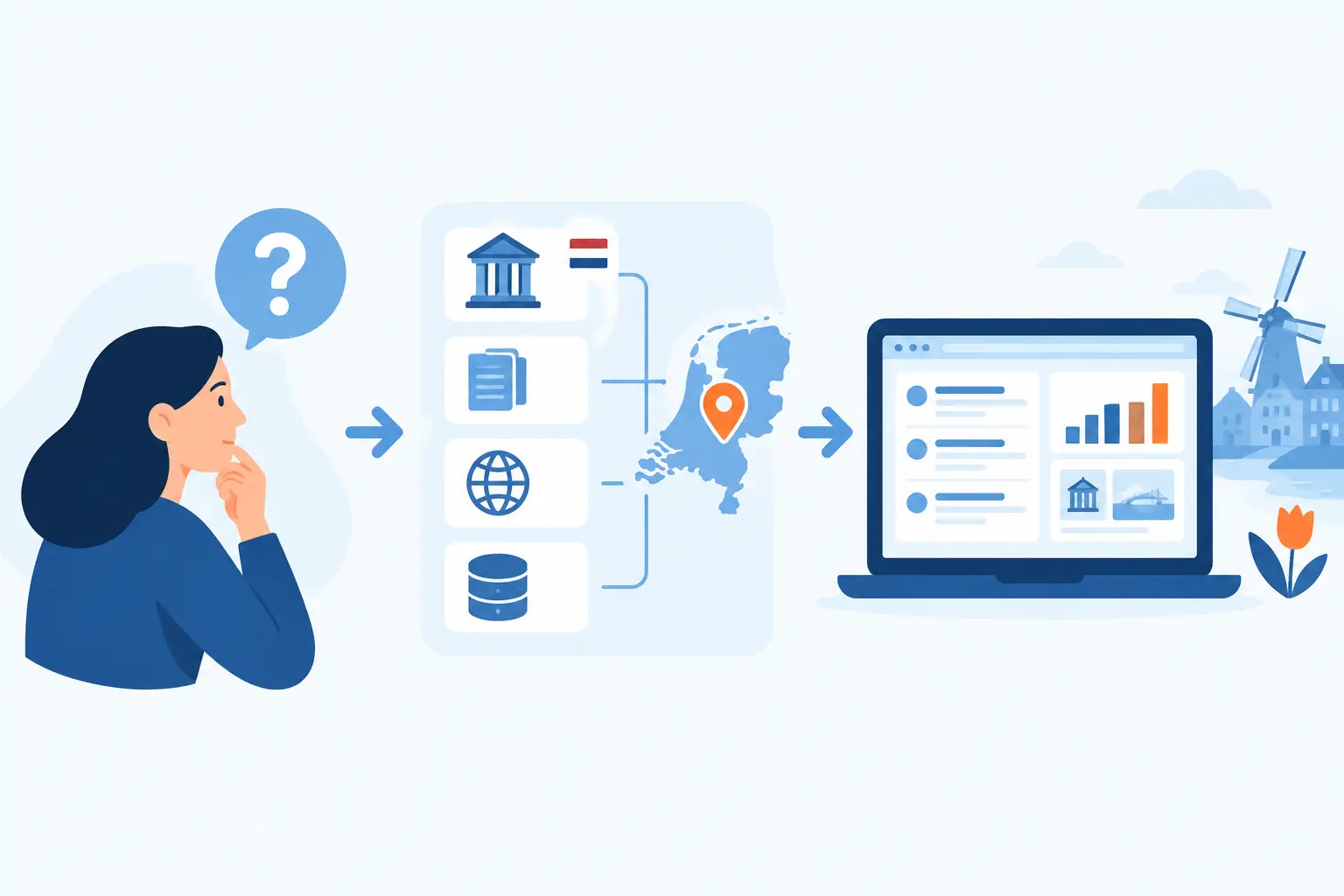
A Dutch municipality publishes a new facilities contract. A ministry opens a technology procurement. A utility announces a major framework agreement. If you need to know where to find Dutch tender data, the useful answer is not one website. It is a source strategy: start with the official publication system, add European notices where relevant, and decide how much history, normalization, and automation your team actually needs.
For a founder looking for public-sector buyers, a consultant tracking competitors, or a researcher sizing a market, tender data can show demand before a contract is awarded. It can also create noise quickly. The difference is knowing what each source contains, what it leaves out, and how to turn a notice into a decision.
Where to find Dutch tender data: start with TenderNed
TenderNed is the Netherlands' official online procurement platform for public contracting authorities. It is the first place to search for Dutch public procurement notices, tender documents, questions and answers, procurement updates, and award-related information when published through the platform.
Search TenderNed when you want to identify active opportunities in the Dutch public sector. Its notices commonly include the contracting authority, procurement procedure, CPV classification codes, deadlines, estimated or stated values where disclosed, documentation, and contact details. Depending on the procedure and the notice, you may also see the selected supplier or award outcome.
The platform is free to access. That makes it the right starting point for occasional research, sales teams qualifying a short list of opportunities, and businesses that can review notices manually. The real cost is time: building searches, opening documents, tracking deadline changes, and comparing terminology across buyers.
TenderNed is not a complete record of every organization that buys goods or services in the Netherlands. Private-sector procurement is generally outside its scope. Smaller purchases may not require the same public publication route. Some information can also be limited by the procurement stage, confidentiality, or the way the buyer completed the notice.
Search beyond your product name
A keyword search alone will miss relevant work. Public buyers often describe needs in formal, functional, or Dutch-language terms rather than using a vendor's preferred product category.
Combine plain-language keywords with CPV codes, the Common Procurement Vocabulary used across European public procurement. If you sell data engineering services, for example, search related technical terms, consulting terms, software terms, and relevant CPV categories. Then filter by buyer type, region, procedure, contract value, and closing date where available.
This takes some judgment. A broad query finds more potential leads but requires more review. A narrow CPV filter reduces noise but can exclude notices classified imperfectly. For market research, broad first and narrow later is often the better approach.
Use TED for EU-level procurement notices
TED, Tenders Electronic Daily, is the European Union's procurement publication service. It carries notices that fall under EU public procurement rules, including Dutch notices that meet the applicable thresholds or otherwise need publication at the European level.
For Dutch tender research, TED matters for two reasons. First, it can surface high-value Dutch opportunities that deserve attention. Second, it gives you a consistent way to compare Dutch public demand with procurement activity elsewhere in Europe.
TED is also free to search. It provides structured notices, downloadable information, and filters that can support research by country, buyer, sector, procedure, and notice type. A business expanding from the Netherlands into nearby European markets can use the same research framework across jurisdictions.
Do not treat TED as a substitute for TenderNed. The two sources overlap, but they do not serve exactly the same purpose. TenderNed is closer to the Dutch procurement workflow and may contain documents or process detail that is more practical for responding to a Dutch opportunity. TED is particularly useful for EU-published notices, cross-border analysis, and broader market comparisons.
Find awarded contracts, not just open tenders
Open notices tell you where buyers are spending attention. Award notices can tell you where money has already gone. That distinction matters when you are building an account list, assessing competitors, or estimating renewal timing.
Look for contract award notices and prior information notices in both TenderNed and TED. Award data may identify the winning supplier, contract value, lot structure, procurement method, and the contracting authority. This can help a consulting team identify buyers that use external providers, or help an investor understand which vendors have won public demand in a category.
But award data has limits. A named winner does not always reveal the full commercial picture. Framework agreements may have multiple suppliers. The stated value can be an estimate, a maximum, or the value of a specific lot rather than the buyer's total future spend. An award may also follow a process that began months earlier.
Treat an award as a research signal, not a final financial fact. Read the notice type and procurement documents before putting the number into a market model.
When a portal search is not enough
Manual portal research works when the question is small: Which IT tenders close this month? Which municipalities are buying fleet services? Who won a particular contract?
It breaks down when the work becomes recurring. A business development team may need daily monitoring across dozens of terms and categories. A researcher may need a clean historical dataset across thousands of notices. A product team may need procurement events inside an internal workflow, CRM, dashboard, or AI-assisted research process.
At that point, the key question is not simply where to find Dutch tender data. It is how you will receive, standardize, and maintain it.
A structured data provider or API can reduce repetitive work by delivering fields such as notice IDs, dates, buyers, values, procedures, CPV codes, locations, source records, and notice status in a form your systems can use. This can make a major difference when you need to match tenders against a company database, monitor a competitor, or trigger alerts for a defined market segment.
The trade-off is cost and source coverage. Official portals are free, while paid data access is usually priced around the data source, history, update frequency, volume, format, and intended use. Before paying for access, ask direct questions: Which source records are included? Are documents included or only notice metadata? How often is the data updated? How are corrections, cancellations, and duplicate notices handled? Can you identify the original source record?
Those answers matter more than a generic promise of comprehensive tender coverage.
Build a procurement research workflow that leads somewhere
The best workflow starts with the decision you need to make. If your goal is sales, define the ideal buyer, likely contract size, relevant categories, and geography before creating alerts. If your goal is market analysis, define the period, buyer groups, and spend signals you will count.
Then separate discovery from qualification. Discovery is broad: collect notices that might fit. Qualification is narrower: read the documents, check eligibility requirements, assess the timeline, identify incumbent suppliers where possible, and decide whether the opportunity is worth pursuing.
For example, a software company might monitor Dutch municipalities for digital service and data-management terms. A new notice enters the pipeline. The team checks whether the procurement is an open procedure, whether the contract is split into lots, whether required references exclude newer suppliers, and whether the buyer is requesting implementation, licenses, or both. That review prevents a promising headline from becoming wasted bid effort.
Keep a record of why opportunities were rejected as well as why they were pursued. Over time, that creates a usable view of which buyer types, procedures, and contract sizes lead to real revenue.
Check the details before acting
Tender notices are operational documents, not marketing copy. Dates can change, documents can be updated, and requirements can appear in attachments rather than the notice summary. Always verify the latest source record before submitting a response or making a high-stakes claim from the data.
Pay close attention to the submission deadline and time zone, the language of the procedure, eligibility criteria, requested certifications, selection criteria, lot structure, and communication rules. A tender that fits commercially may still be unsuitable if its minimum requirements do not match your business.
Dutch tender data is most valuable when it becomes part of a repeatable process: find the right notices, verify the primary documents, and act only when the opportunity fits your strategy. The public record gives you the signal. Your workflow turns it into a better next move.