
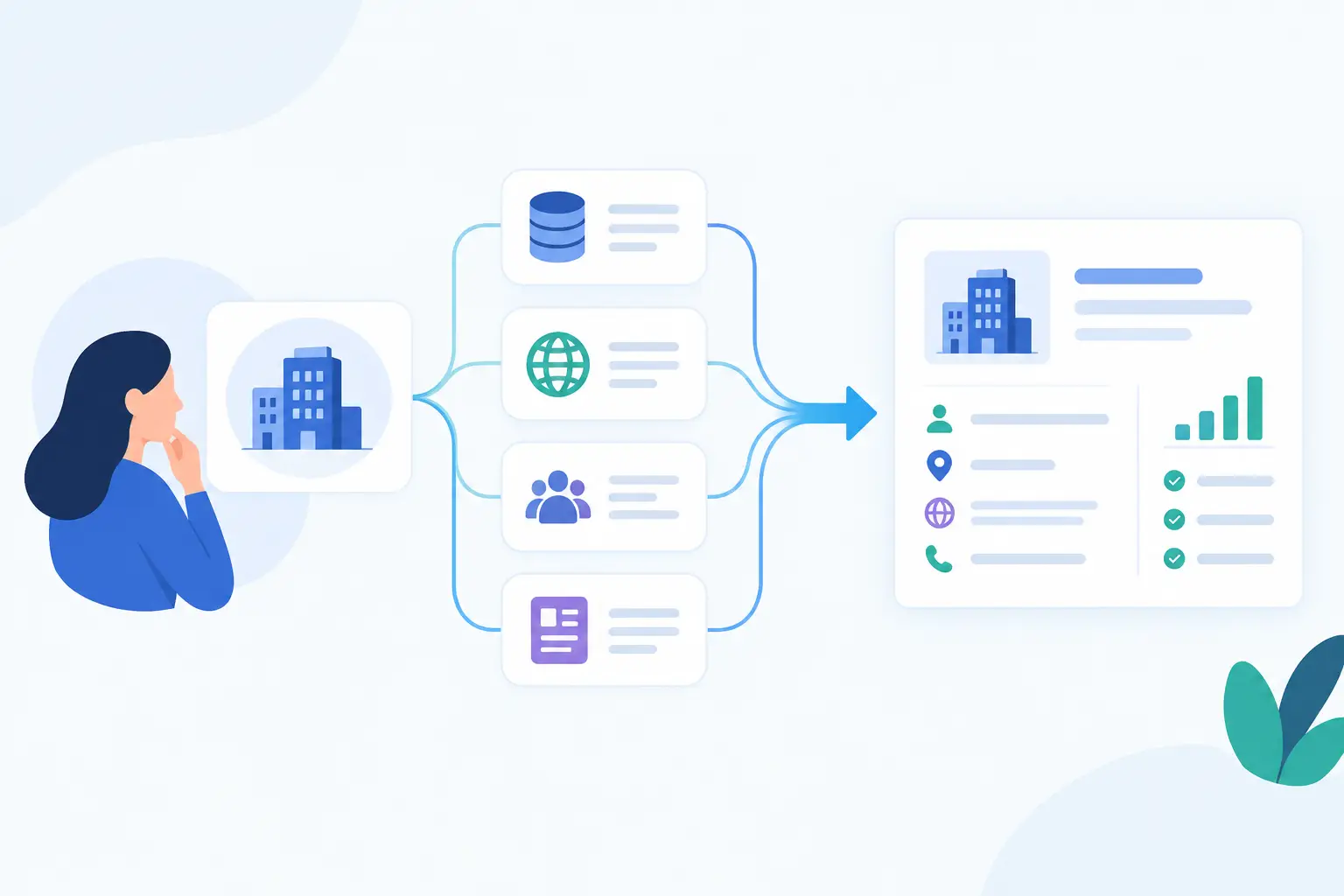
A company record with only a name, website, and email address is rarely enough to make a confident business decision. What is company data enrichment? It is the process of adding relevant, sourced information to an existing company record so a team can understand who the business is, how it operates, and whether it fits a specific need.
For a founder, that may mean identifying companies in a market that meet a defined size or location threshold. For an investor, it may mean connecting a legal entity to directors, filings, subsidiaries, and public contracts. For a sales team, it may mean turning a basic lead list into accounts with industry, employee range, ownership details, and contact context. The goal is not to create a bigger spreadsheet. The goal is to make the next decision easier to defend.
What company data enrichment adds to a record
Enrichment starts with an identifier. This could be a legal company name, registration number, website domain, VAT number, address, or a combination of fields. That identifier is matched against one or more data sources, and the resulting attributes are appended to the original record.
The useful attributes depend on the decision at hand. A procurement team may need legal status, beneficial ownership information where available, sanctions-related screening data from appropriate sources, and prior public contract activity. A market researcher may need industry classifications, geographic footprint, subsidiaries, directors, financial filings where disclosed, and government awards. A developer building a business verification workflow may need a stable registration number, active or inactive status, and registered address.
Common enrichment fields include:
- Legal name, registration number, jurisdiction, and company status
- Registered address, operating locations, website, and known domains
- Industry classifications, business descriptions, and company size indicators
- Directors, officers, shareholders, and parent or subsidiary relationships where source coverage permits
- Filing history, financial disclosures, public tenders, contracts, and other published records
- Data quality signals, such as match confidence, source date, and last-updated date
Not every source provides every field. A private company may publish very little beyond registry information. A larger public company may disclose extensive filings but use a complex corporate structure that makes entity matching harder. Good enrichment makes those gaps visible instead of quietly filling them with assumptions.
How company data enrichment works
The work is often described as a simple lookup, but reliable enrichment has several steps. First, the system normalizes the data it receives. “Acme Inc.,” “Acme Incorporated,” and “ACME, INC” may refer to the same entity, but they need to be standardized before matching.
Next comes entity resolution: determining whether the input record and a source record truly describe the same company. Names alone are weak identifiers, especially for businesses with common names or international operations. Registration numbers are stronger. Domain, address, jurisdiction, and director information can provide additional evidence.
Once there is a match, the system retrieves relevant fields from available sources and returns them in a usable structure. That may be a research response, a downloadable dataset, an API response, or data passed into an internal workflow. Finally, the enrichment should retain provenance: where a field came from, when it was collected or published, and what it means.
That last step matters. “Revenue” could mean a figure from a statutory filing, a third-party estimate, or a number supplied by the company itself. Those are not interchangeable. Users should be able to distinguish reported data from modeled or inferred data before relying on it.
Why enriched company data changes decisions
The value of enrichment is speed with context. Teams often spend hours moving between company websites, registries, filing portals, news databases, and procurement sites to answer what sounds like a simple question: Is this company legitimate, relevant, active, and worth pursuing?
Enrichment reduces the repetitive part of that work. It can show that a prospective customer is part of a larger group, that a vendor has changed legal status, or that a target company has an established history of public-sector contracts. It can also prevent wasted effort by exposing duplicates, dissolved entities, mismatched jurisdictions, or records that cannot be verified from the available evidence.
For business development, enriched data supports better account prioritization. A team can segment companies based on actual operating signals rather than relying only on job titles or self-reported website copy. For research and consulting, it makes it easier to build a defensible market view and trace claims back to source records. For product teams, it can reduce manual onboarding checks and give users more complete company profiles.
The benefit is not that every record becomes perfect. It is that the uncertainty around each record becomes more manageable.
Company data enrichment versus data cleaning
Data cleaning and enrichment are related, but they solve different problems. Cleaning improves the data you already have. It removes duplicate records, standardizes state or country names, fixes formatting, and flags missing values. Enrichment brings in new information from outside sources.
A customer list with “Netherlands” in one row, “NL” in another, and a blank country in a third needs cleaning. Adding legal entity details, registration status, industry codes, or contract history to that list is enrichment. In practice, teams need both. An enrichment provider will struggle to match unreliable input data, while a perfectly cleaned list may still lack the context needed for action.
Sources, coverage, and the limits that matter
The best enrichment approach uses the right source for the question. Official registries can provide legal entity details and filing information. Government procurement databases can show awarded contracts or tender participation. Commercial datasets may add broader firmographic coverage, standardized classifications, or relationship mapping. Company websites and public disclosures can add operating context, but should not be treated as independent verification.
Coverage varies by country, source, entity type, and field. European company data, for example, is governed by different publication rules across jurisdictions. One registry may expose director information and annual filings, while another provides only basic registration details. Public contract data may be rich at the national level but incomplete across local authorities or older records.
Timeliness also varies. A legal status change may appear quickly in an official registry, while a commercial database may refresh on a different schedule. A record that was accurate last quarter may no longer describe the company today. For sensitive decisions, teams should check the source date and, where needed, validate the most important facts directly against the underlying record.
There are legal and ethical limits as well. Company information can overlap with personal data, particularly for sole proprietors, directors, and beneficial owners. Teams should use data for a defined business purpose, respect applicable privacy rules, and avoid collecting more information than the workflow requires.
Choosing the right enrichment workflow
The right setup depends on volume and urgency. If you are researching ten potential partners, a natural-language request can be the fastest route: ask for active companies in a sector, in a location, with specific public contract activity or corporate characteristics. If you are validating thousands of companies during onboarding, an API-based workflow is usually more practical.
For recurring work, define the output before requesting the data. Decide which fields are required, which are useful but optional, and what counts as an acceptable match. A sales workflow might accept a probable domain match for early-stage prospecting. A compliance or contract workflow may require an exact legal registration number and a documented source trail.
Apiosk can be useful when teams need to access government and commercial data through natural-language requests, APIs, or AI integrations. The practical advantage is not replacing judgment. It is making relevant source-backed data easier to retrieve and fit into the tools where decisions already happen.
Cost should be evaluated the same way. Some use cases justify premium, frequently refreshed records because a bad match is expensive. Others need broad, lower-cost coverage for market mapping, with deeper verification reserved for shortlisted companies. Ask what sources are included, what geographic coverage applies, how often records are refreshed, whether individual fields carry source information, and how usage is priced.
Start with the decision, not the dataset
Company data enrichment works best when it begins with a precise question: Which companies should we contact? Is this supplier the legal entity we think it is? Which firms have won public contracts in this category? What corporate relationships should we understand before a meeting?
Start there, request only the evidence needed to answer it, and keep the source and date attached to the result. That discipline turns enrichment from a larger database into a more useful way to make business decisions.