
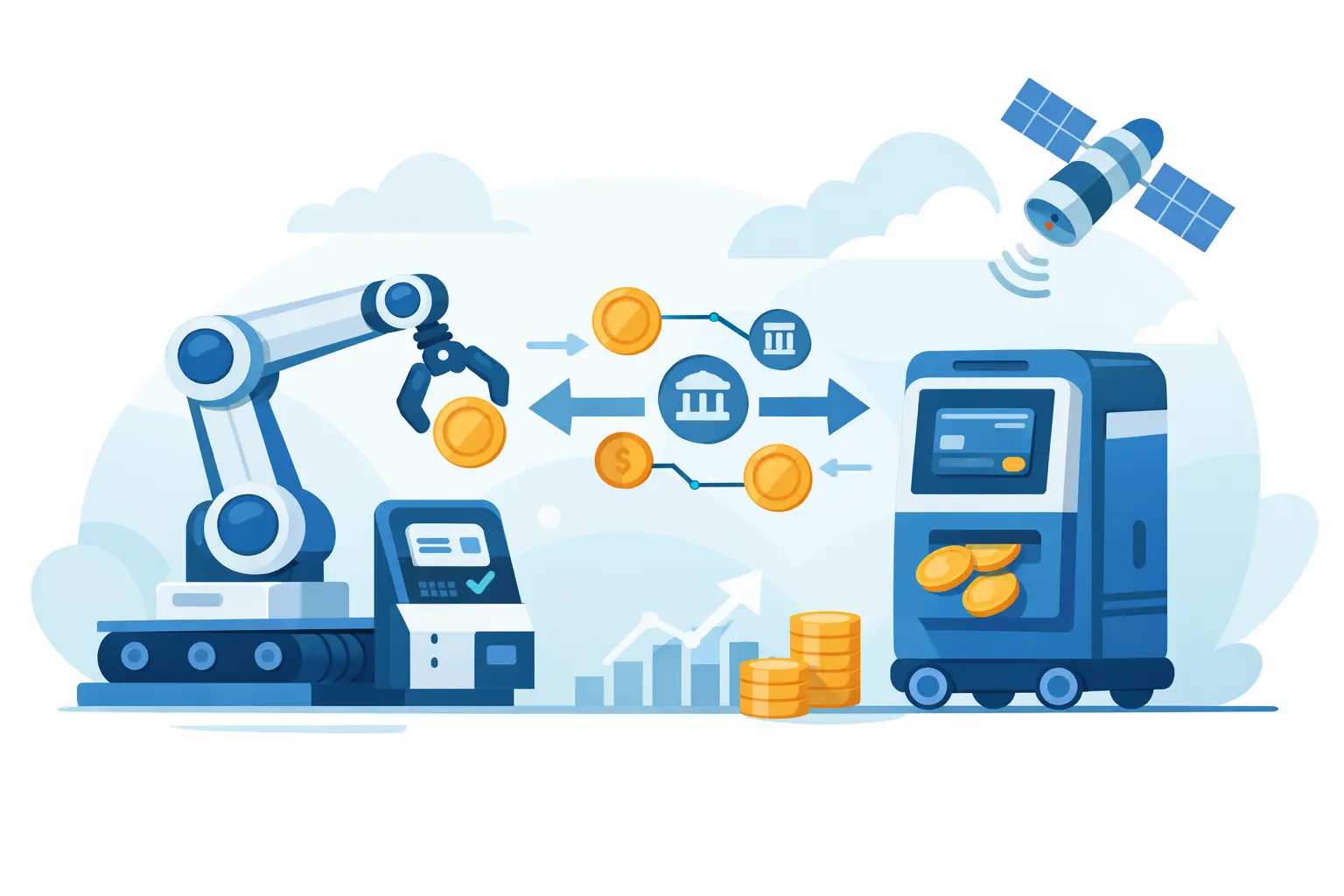
An AI agent calls your API 40,000 times in a day, pays for each request, and never talks to a sales rep. That is not a future concept. It is the operating model behind machine to machine payments, and it is starting to matter anywhere software is sold by usage, execution, or data access.
The interesting part is not that a machine can send money. The interesting part is whether that payment can become usable business revenue without creating a second job for engineering and finance. That is where most of the market still breaks down.
What machine to machine payments actually change
Machine to machine payments are payments initiated, authorized, and completed by software rather than a human clicking checkout. In practice, that usually means an AI agent, application, service, or device pays another system directly for access to compute, APIs, datasets, content, or task execution.
For digital businesses, this changes the shape of monetization. Traditional billing was built for people. A user signs up, enters card details, and gets billed monthly. That model works when consumption is predictable and buyer intent is slow enough to support onboarding friction. It works far less well when an agent wants to pay for one request, one result, or one burst of usage right now.
That gap matters because agentic software does not buy like a human buyer. It does not want procurement cycles. It does not want manual invoicing. It does not want seat-based pricing when it needs a single action completed in milliseconds.
Machine-native commerce pushes payments down to the execution layer. If the product is programmable, the payment has to be programmable too.
Why machine to machine payments are showing up now
This shift is happening now because two pieces are finally lining up.
First, AI agents are becoming active economic actors. They browse, evaluate, call tools, trigger workflows, and make autonomous choices about which service to use. Once that behavior exists, a payment layer follows naturally.
Second, stablecoin rails have made low-value, high-frequency internet payments practical. Card rails were never designed for a stream of tiny transactions between systems. Fees are too high, authorization flows are too slow, and chargeback logic assumes a consumer context. Stablecoins change the economics. They make it possible for an application to pay another application in small increments without the payment cost swallowing the underlying revenue.
That does not mean every business should replace subscriptions with micropayments. It means businesses now have a credible option for monetizing dynamic, machine-driven demand that did not fit older payment models.
The real use case: monetizing execution
The cleanest use case for machine to machine payments is not retail commerce. It is paid execution.
If you run an API, an MCP server, a dataset marketplace, a model wrapper, or a specialized digital service, your product already lives in a machine-readable environment. The hard part is not exposing access. The hard part is charging for that access at the exact moment value is delivered.
That changes pricing strategy. Instead of forcing every customer into monthly contracts, you can charge per request, per workflow step, per retrieval, per file, or per outcome. That opens the door to new demand from autonomous systems that would never complete a traditional sales funnel.
For many teams, this is less about replacing enterprise pricing and more about capturing a new revenue class. Usage from agents is often high volume, fragmented, and difficult to invoice cleanly after the fact. If the payment happens before or during execution, revenue is authorized in real time.
Where most teams get stuck
The technical story around machine to machine payments is getting better. The operational story is still where things get painful.
A lot of teams can imagine accepting USDC from an agent. Fewer teams want to hold crypto on their balance sheet, reconcile thousands of small transfers manually, or explain fragmented wallet activity to finance. The payment rail may be machine-native, but the business still closes books in fiat, settles to a bank account, and reports revenue through existing systems.
This is the core trade-off. If you optimize only for payment programmability, you can create finance chaos. If you optimize only for traditional finance processes, you miss the speed and granularity that machine-native demand requires.
The right setup has to bridge both sides.
What a workable machine to machine payments stack looks like
A useful stack does four things well.
It accepts payment at the protocol or API layer, where the machine interaction actually happens. It supports stablecoin flows because that is where low-friction machine payments are strongest today. It converts those inflows into fiat-denominated business revenue. And it exports the result in a way finance can reconcile without building custom logic around every wallet event.
That is a much higher bar than simply saying you support crypto.
If you are evaluating infrastructure, ask a basic question: does this produce cleaner business operations, or does it just move complexity from product into finance? Many solutions stop at transaction acceptance. That helps with collection, but not with settlement, reconciliation, bookkeeping, or payout.
For European operators especially, this distinction matters. A payment system is not complete when a wallet receives funds. It is complete when euros land in the bank account with records that match the ledger.
Machine to machine payments need finance-grade settlement
This is where a lot of early machine payment narratives become too abstract. Revenue is only useful when it fits the real operating environment of the business.
If your team serves AI traffic but reports in euros, then stablecoin acceptance is only one step in the chain. You still need conversion, settlement, payout timing, reconciliation logic, and accounting-ready reporting. Without that, every small machine payment creates downstream manual work.
That is why the strongest infrastructure in this category is not just payment acceptance. It is payment-to-bookkeeping infrastructure.
For example, a provider might accept AI-native payments over rails such as x402, receive stablecoins for paid API execution, and settle out as euros to a bank account with reconciliation built in. That model preserves the benefits of machine-native payment collection without forcing the company to become a crypto operations desk. Apiosk is built around exactly that bridge.
How to think about pricing in a machine economy
Machine to machine payments make more pricing models possible, but they do not automatically make pricing simpler.
Per-call pricing works when value is uniform and easy to measure. Per-result pricing can be stronger when customers care about completed work rather than raw usage. Hybrid models often make sense if you need a committed spend floor with pay-as-you-go overages for agent traffic.
The key is to price at the point where value is both observable and enforceable by software. If your price metric depends on downstream business outcomes you cannot verify in real time, fully automated collection gets harder. If the metric maps directly to execution, authorization becomes straightforward.
This is one place where restraint matters. Just because machine payments can support tiny increments does not mean you should fragment your pricing endlessly. Buyers, including AI buyers, still need predictability. Good monetization architecture should increase flexibility without making spend impossible to understand.
What adoption will look like from here
Machine to machine payments will not replace every existing payment flow. Enterprise contracts, subscriptions, and invoicing are not going away. They remain useful for planned consumption, negotiated pricing, and long-term commitments.
What will grow is the share of revenue that starts as software-driven usage and gets captured at the moment of execution. That is especially true for APIs, tools, data products, and services consumed by agents rather than people.
The winners in this shift will not be the companies with the most experimental payment stack. They will be the ones that make new demand easy to monetize without disrupting the rest of the business. Crypto in is not enough. Settlement, control, and reporting are what make the model commercially usable.
That is the practical standard to use. If machine to machine payments can turn autonomous consumption into clean, settled revenue, they are worth deploying. If they create more operational drag than monetization upside, they are still a lab project.
The market is moving past the lab stage. The next question is simpler: when software starts buying from software, will your business be ready to get paid?