
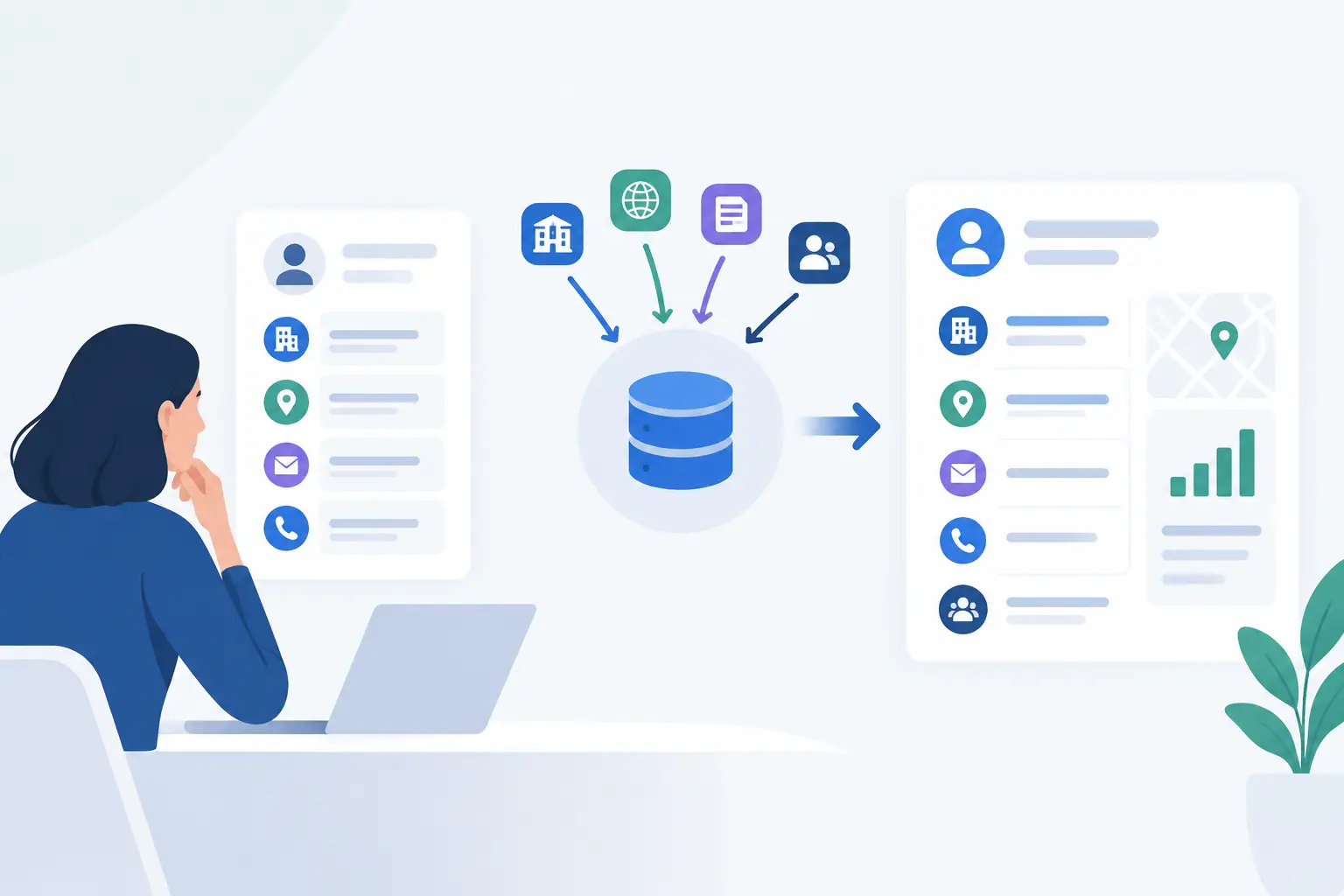
A company name is rarely enough to make a confident business decision. You may know that a prospect exists, but not its legal entity, current status, ownership structure, public contracts, industry, or connection to related businesses. A guide to commercial data enrichment starts with that gap: turning a thin record into information a person, team, or application can use.
Commercial enrichment is not about collecting every available field. It is about adding relevant, traceable context to records so you can qualify opportunities, assess counterparties, research markets, monitor vendors, or power product workflows with less manual work.
What commercial data enrichment means
Commercial data enrichment is the process of appending information to an existing business record using external data sources. The starting record might contain a company name, website domain, registration number, address, executive name, or tax identifier. The output may include legal registration details, corporate status, classification codes, addresses, directors, filings, financial indicators, procurement activity, subsidiaries, and other available commercial signals.
The best enrichment workflow does two things at once. It improves the record itself and preserves enough source detail to let the user judge whether the result fits the decision at hand.
For example, a consulting firm building a target list may want a verified legal name, company status, location, employee range, and industry classification. An investor researching a private company may care more about directors, beneficial ownership where available, historical filings, related entities, and public contract awards. A developer may need a structured answer that an internal tool can consume without asking an analyst to visit five different registries.
Those are different jobs. They should not be served by the same oversized, unfiltered company profile.
Start with the decision, not the data fields
Teams often begin enrichment by asking, “What can we get?” A better question is, “What decision should this record support?” That distinction prevents expensive data collection and confusing workflows.
If your sales team needs to prioritize accounts, identify the signals that change outreach priority. Legal status, company size, industry, location, and recent procurement activity may matter. If you are onboarding suppliers, you may need entity verification, registration status, registered address, and signs that the organization is active. If you are mapping a market, you may need a consistent classification system and a way to identify corporate groups without counting the same business twice.
Write down three things before selecting a source: the entity you need to identify, the fields that influence the decision, and the acceptable age of the data. A registration status checked last week is useful for onboarding. A six-month-old snapshot may be enough for a broad market study. Freshness is not an abstract quality measure. It depends on the use case.
The most useful enrichment categories
A practical enrichment program usually combines a few categories rather than relying on a single source.
Entity resolution and legal identity
This is the foundation. Entity resolution connects inconsistent inputs to the correct company. “Acme Holdings,” “Acme Holding BV,” and a domain name may point to one organization, or they may not. Matching logic can use official identifiers, names, addresses, websites, and geographic clues to reduce ambiguity.
Official registration numbers are especially valuable because names change and duplicate names are common. But even identifiers have limits. A group can operate through multiple legal entities, and the entity signing a contract may not be the one the customer recognizes as the brand.
Company profile and operating context
Once the legal entity is identified, profile data makes the record usable. Common fields include addresses, incorporation date, operating status, industry codes, business descriptions, leadership information, and web presence.
This context helps teams segment records and spot obvious mismatches. A business described as a construction contractor should not automatically be treated as a software buyer because its website contains a technology keyword. Source-backed classifications and a human review path are often safer than a single automated label.
Corporate relationships
Parent companies, subsidiaries, branches, directors, and ownership data can reveal relationships that simple lead lists miss. This is valuable when assessing concentration risk, identifying a buying group, or understanding whether two vendors are connected.
Relationship data needs careful interpretation. Ownership disclosure rules vary by jurisdiction. Records may reflect direct ownership rather than ultimate control, and filings can lag behind real-world changes. Treat corporate graphs as research evidence, not as a final verdict.
Financial and public activity signals
Available filings, reported financial data, public tenders, contract awards, and regulatory notices can add useful evidence about an organization’s activity. A contract award may show that a company sells into the public sector. A filing can offer a view of an entity at a particular reporting date.
These signals are meaningful only with their dates and source context attached. A historical filing does not prove current financial condition. A public contract award does not necessarily equal realized revenue. Good enrichment keeps these distinctions visible.
How to evaluate commercial data sources
The right source depends on your geography, entity type, coverage needs, and tolerance for manual review. Official registries often provide strong legal identity data, while commercial aggregators can make multiple datasets easier to search and use programmatically. Neither is automatically sufficient on its own.
Assess a source on four practical questions:
- What entities and locations does it cover, and where are the gaps?
- Which fields come directly from official records, and which are modeled or inferred?
- How often is the source updated, and is the update date available per record?
- Can you retrieve the source reference, identifier, and confidence or match rationale when needed?
Coverage deserves more attention than most buyers give it. A provider may be excellent for incorporated businesses in one country and sparse for sole proprietors, branches, or newer entities in another. For European research, source availability and disclosure rules can differ substantially between jurisdictions. Test with a sample of companies you already know before committing to a broad rollout.
Cost should also be evaluated in terms of the workflow, not just the price per record. A lower-cost dataset can become expensive if your team spends hours resolving duplicates or checking unclear matches. Conversely, premium data is hard to justify when a public source provides the few fields your workflow truly needs.
A guide to commercial data enrichment in five steps
Begin with clean inputs. Normalize company names, separate address components, retain country information, and store any known identifier or website domain. Do not overwrite original values. The original input is essential when a match needs to be reviewed later.
Next, match records in stages. Use exact identifiers first, then domain and location, then name and address combinations. Broad name-only matching should produce candidates, not automatic decisions. A match score can help prioritize review, but it cannot remove ambiguity from common names or complex corporate groups.
Then enrich only the fields tied to your use case. A procurement research tool may request tender and award history. A sales workflow may request industry, size indicators, and location. Restricting the request improves speed, cost control, and data handling discipline.
Store provenance with every important result. At a minimum, retain the source, retrieval date, source record identifier, and any transformation applied. When someone asks, “Where did this come from?” the answer should take seconds, not an investigation.
Finally, set refresh rules. Stable attributes such as incorporation date need little maintenance. Status, leadership, address, ownership, and contract activity may need scheduled checks or event-based monitoring. Refreshing every field on every record at the same frequency wastes budget and can create unnecessary noise.
Make enrichment usable in products and workflows
The value of enrichment appears when it reaches the place decisions happen. For a researcher, that may be a structured company brief. For a sales team, it may be a prioritized account record. For an application, it may be an API response that identifies the legal entity and returns cited attributes for a user-facing workflow.
Natural-language access can reduce friction for exploratory work. A user may ask for Dutch construction companies with recent public contract awards, or request the directors and status of a named business. APIs are better suited to repeatable tasks such as verifying a new vendor during onboarding or enriching a batch of accounts overnight. AI integrations can help route questions and format results, but they still need clear source boundaries and validation rules.
Apiosk is designed for this kind of access: ask for commercial or government data in plain language, retrieve it through an API, or bring it into an AI workflow. The useful unit is not a generic data dump. It is an answer tied to a specific business question and the sources available for that question.
Where enrichment can go wrong
The most common failure is treating a match as fact. A high-confidence match is still not the same as a verified identifier, particularly when the record drives a compliance, credit, or contracting decision. Build escalation paths for ambiguous records.
Another failure is confusing availability with permission or suitability. Data that is publicly accessible may still require careful handling under privacy, contractual, and internal governance rules. Personal information about directors and representatives should have a clear business purpose, appropriate access controls, and retention practices.
Finally, avoid false precision. A company profile with dozens of fields can look authoritative while mixing dates, jurisdictions, and inferred values. Show what is known, what is estimated, when it was retrieved, and where the source may be incomplete. That is more useful than a polished profile that hides uncertainty.
The next company record your team touches should not require a scavenger hunt. Define the decision, request the evidence that supports it, and keep the source trail close enough that anyone can verify the answer.