
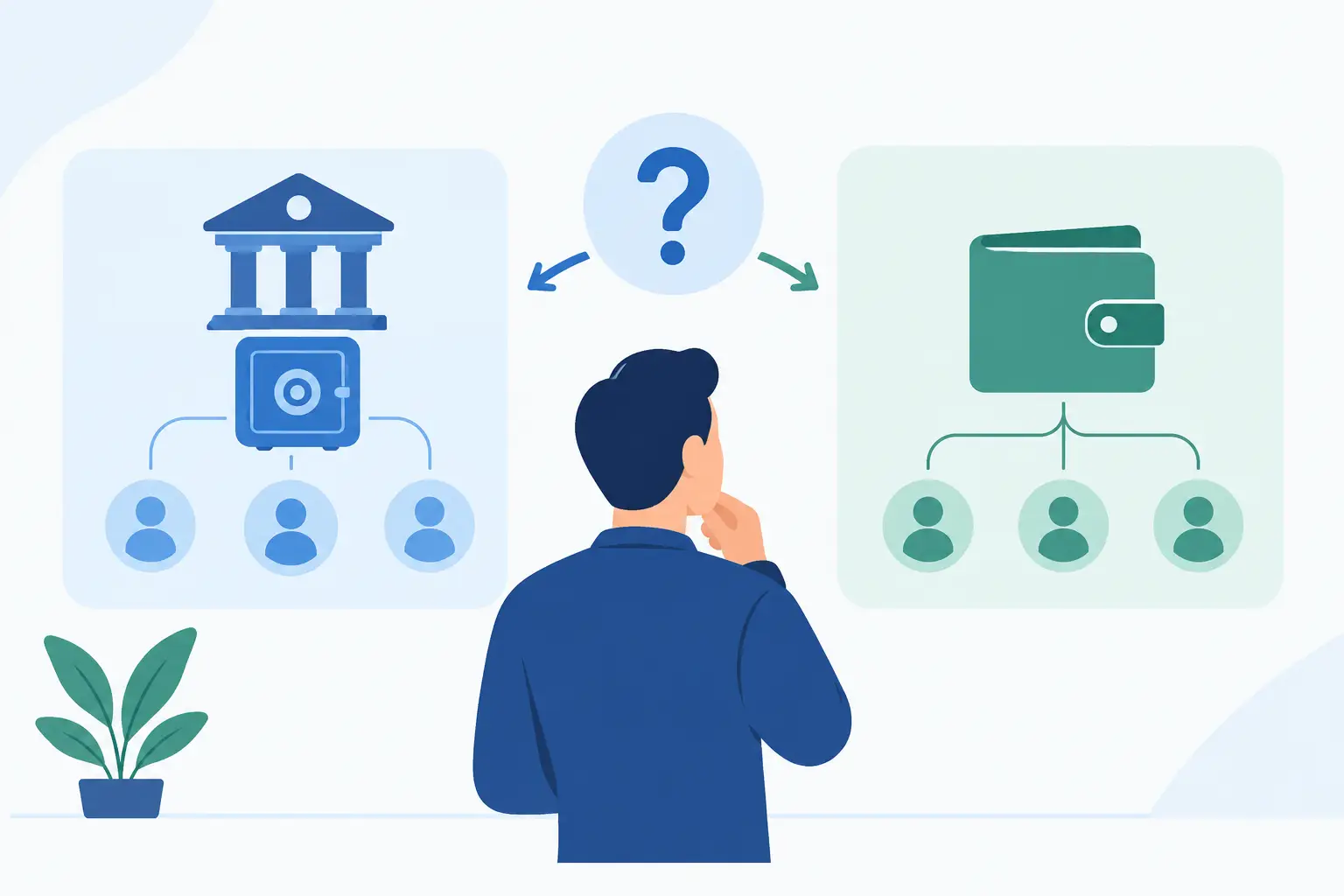
A payment can look complete on a dashboard while the real question remains unanswered: who can actually move the funds? That is the practical distinction behind custodial vs non custodial payments. It affects customer trust, operational workload, compliance responsibilities, incident response, and the product experience your team can realistically support.
For founders and product teams, this is not a philosophical choice about ownership. It is an operating-model decision. One model trades direct control for a managed experience. The other gives users more control, while placing more responsibility on them and often on the product built around them.
What custodial payments mean
In a custodial payment model, a provider holds the credentials or assets needed to authorize transactions on behalf of the user. The customer has an account, balance, or payment profile with that provider. They may initiate payments, but the provider controls the underlying custody and usually enforces the rules for access, approvals, recovery, and transfers.
This is familiar to anyone using a business bank account, a payment processor, or a marketplace balance. The provider maintains the ledger, handles authentication, and can often help when something goes wrong. If a user loses access, the provider may have a recovery process. If suspicious activity is detected, it may pause an account or require additional verification.
For a business, custodial payments can reduce the number of hard choices pushed onto end users. Your product can present account balances, permissions, receipts, payment status, and support workflows without asking every customer to manage sensitive credentials themselves.
That convenience comes with dependence. You need to understand exactly what the provider controls, when funds are available, what restrictions apply, how account closures are handled, and what happens during an outage or review. “Custodial” is not a complete answer. The contract, service design, and operational procedures matter just as much.
What non custodial payments mean
In a non custodial model, the user retains control of the credentials needed to authorize a transaction. The platform may help create a payment request, calculate an amount, confirm a status, or record a transaction, but it does not hold the user’s authorization credentials or have unilateral control over their funds.
The central benefit is direct user control. A platform cannot transfer funds simply because it has access to an internal balance. This can be valuable for customers that need clear separation between their own assets and a vendor’s operating systems.
The trade-off is that lost access may be difficult or impossible to recover. Users must understand their own security responsibilities. They may need to approve each transaction directly, manage permissions carefully, and resolve errors without the same level of provider intervention available in a custodial setup.
For product teams, non custodial does not mean hands-off. You still need to design clear payment states, explain failures in plain English, prevent duplicate requests, and provide reliable records. You also need to be precise about what your system can and cannot do. If a customer must approve a payment themselves, do not present it as automatically settled before that approval and confirmation occur.
Custodial vs non custodial payments: the business trade-off
The right model depends on who needs control, how frequently payments occur, and how much operational responsibility your business is prepared to carry.
Custodial payments usually fit products where convenience and managed operations are the priority. Consider a B2B platform that charges for data access, usage, or recurring services. Customers may prefer a familiar account experience, consolidated billing, team permissions, and a support path when an employee leaves or loses access. The platform benefits from clearer administration and a more consistent checkout flow.
Non custodial payments can fit cases where customers require direct authorization and do not want a service provider holding the means to move their funds. This may appeal to technically sophisticated users, organizations with strict internal controls, or workflows where a payment should be approved by the payer at the point of action.
Neither approach automatically makes a product safer. A custodial provider can offer mature security controls, monitoring, and recovery, but it also creates a concentrated point of failure and dependency. A non custodial design reduces what the platform can control, but users can make irreversible mistakes and may face a steeper learning curve.
The practical question is not, “Which model is best?” Ask, “Which party should have authority at each step, and can that party manage the responsibility?”
Compare the operational realities before you build
Start with support. In a custodial system, users will expect help with access, account recovery, payment reversals where applicable, and transaction questions. Your team needs documented procedures and clear escalation paths with providers. In a non custodial system, support must be especially explicit about the limits of recovery and the actions only the user can take.
Then consider reconciliation. Finance and operations teams need to connect a payment event to an order, invoice, service entitlement, or data request. A good implementation records a stable reference ID, payment amount, currency, timestamps, payer and payee context where available, and the final state of the transaction. Do not rely on a screen capture or a single status label as your audit trail.
Permissions also deserve attention. A founder may be able to authorize every early payment, but that does not scale. Define who can create payment requests, approve payments, view transaction history, export records, and change payout details. Separate those permissions where the risk justifies it.
Finally, plan for exceptions. Payments can remain pending, fail, be sent with an incorrect reference, or require review. Your product should tell the customer what happened, what they should do next, and when they should contact support. Vague messages such as “payment error” create avoidable tickets and delayed revenue.
Questions to ask a payment provider
Before choosing a custodial provider or integrating a non custodial flow, get specific answers. Ask who holds customer funds or credentials, who has authority to initiate transfers, and what evidence confirms a payment is final. Ask about account recovery, service interruptions, transaction limits, dispute handling, and the availability of exports for finance systems.
Also ask about geographic and entity coverage. Availability, verification requirements, currencies, and settlement options can vary by customer location and legal entity. If you serve European customers, for example, do not assume that a provider’s U.S. workflow or support model applies unchanged.
For API-based products, test the integration around real events rather than only the happy path. Can your system reliably distinguish a created payment request from an authorized payment, a pending payment, and a completed payment? Can it safely retry a request without charging twice? Can an AI agent request access to paid data without being given authority it should not have? These design details determine whether payments become a dependable part of your workflow or a recurring source of manual cleanup.
Choose the model your customers can operate
A custodial model is often the clearer choice when your product needs managed access, recoverable accounts, delegated team permissions, and a predictable support experience. A non custodial model is often the better fit when direct user authorization is central and customers can comfortably manage their own payment controls.
You can also separate the decisions. A customer may use a managed business account for routine purchases while requiring direct approval for higher-value transactions. The key is to describe the boundary plainly. Say who holds what, who can authorize what, and what happens when something fails.
Payment design should make the next action obvious, not make customers decipher your infrastructure. When authority, records, and recovery paths are clear, teams can focus on the work the payment enables - whether that is buying reliable company data, running research, or delivering a product their own customers trust.