
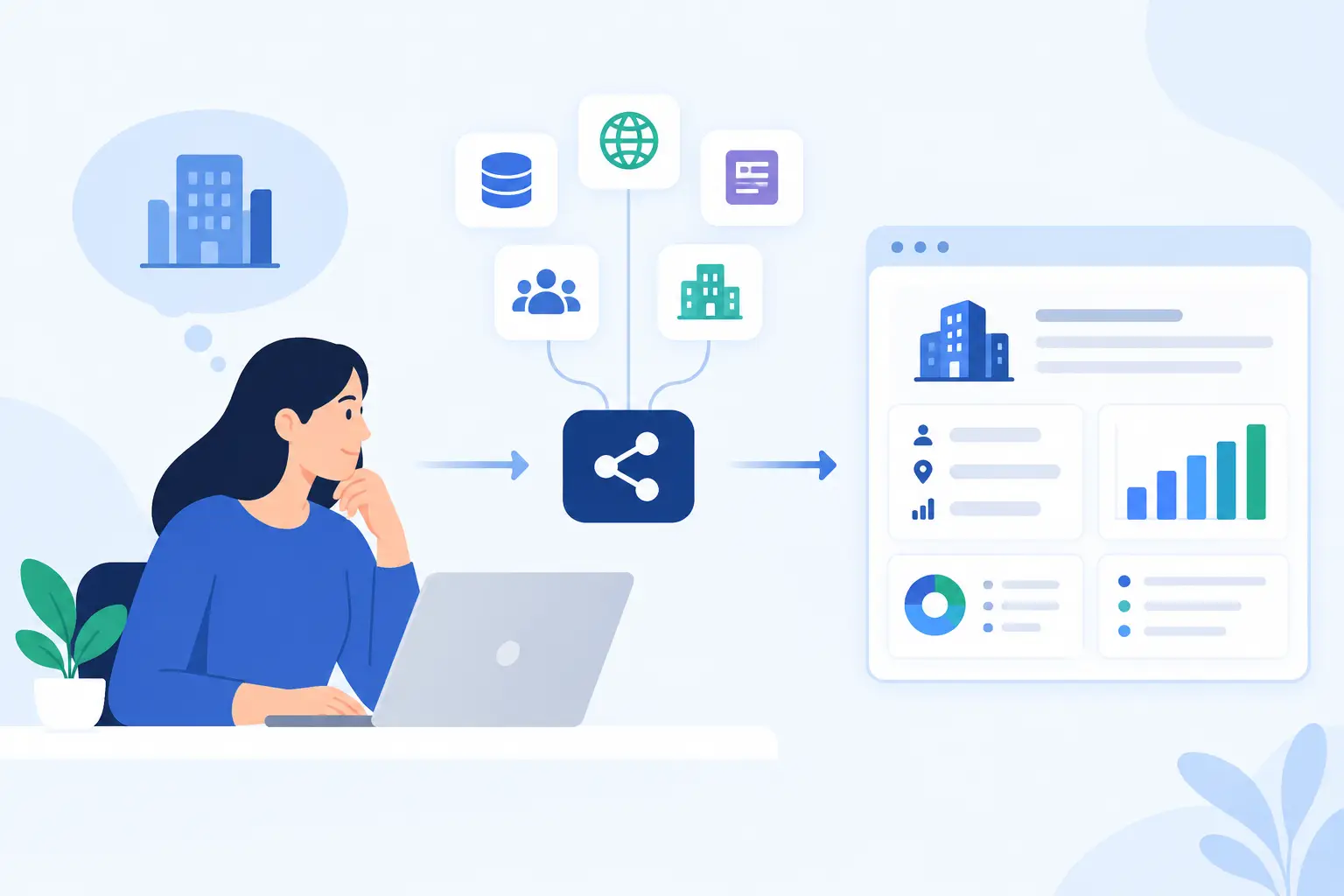
A company name is not a company record. The same business can appear under a trading name, a legal entity name, a parent company, and several local registrations. That is why the best APIs for company research are not simply the ones with the largest datasets. They are the ones that give your team the right source, the right identifiers, and enough context to make a decision.
A founder checking a vendor, an investor screening a market, and a developer building an onboarding flow need different answers. One may need incorporation status. Another may need public filings and beneficial ownership signals. A third may only need to confirm that a company exists and is active. Start with the question, then choose the API.
There Is No Single Best Company Research API
Company research spans several distinct data types: legal registration details, financial filings, ownership, funding, employee and technology signals, sanctions and watchlists, procurement records, and contact or firmographic data. No provider is equally strong in all of them.
Official registries are usually the best source for a company’s legal status in a specific jurisdiction. Public market regulators are the authority for issuer filings. Commercial providers can add normalization, global matching, historical records, and convenience, but their coverage and refresh schedules vary.
The practical answer is often a source-first stack. Use an official source when legal evidence matters. Add commercial data when you need to find related entities, compare companies across countries, or enrich a workflow at scale. This approach also keeps costs under control.
Best APIs for Company Research by Use Case
1. OpenCorporates for broad registry discovery
OpenCorporates is a useful starting point when you need to search across company registries rather than work from a single country’s register. It can help identify likely legal entities, alternate names, company numbers, jurisdiction, and available registry references.
Its strength is discovery and normalization across many jurisdictions. Its limitation is equally important: the depth, freshness, and fields available depend on the original registry. Treat it as a strong way to locate a record, not automatic proof that every field is current or complete. API access and commercial terms should be reviewed for the volume and use case you have in mind.
2. Official registry APIs for legal status
If you need to verify an entity’s active status, registered address, directors, or filing history, go to the relevant official registry where an API or structured data service is available. The UK Companies House API is a clear example. It provides company profiles, filing history, officer information, and people with significant control for UK entities.
Official APIs are often inexpensive or free for modest use, though they commonly have authentication, rate, attribution, and fair-use requirements. They also tend to be jurisdiction-specific. A US LLC, a Dutch BV, and a UK limited company do not belong in the same lookup flow unless your product handles country-level source differences explicitly.
3. SEC EDGAR for US public-company filings
For US listed companies and other SEC registrants, EDGAR is the primary research source. It provides filings, structured financial facts, issuer identifiers, and filing metadata. This is the right place to investigate a public company’s stated risks, revenue, material events, executive compensation, or acquisition disclosures.
EDGAR is not a general company database. It will not solve private-company research, verify every operating subsidiary, or provide a polished account hierarchy. The data is public and highly valuable, but teams need to account for filing formats, amendments, reporting periods, and issuer identifiers. For investor research and financial analysis, those details are the work.
4. GLEIF for legal entity identifiers and relationships
The Global Legal Entity Identifier Foundation, or GLEIF, provides open access to Legal Entity Identifier reference data. An LEI is especially useful in financial and regulated contexts because it helps distinguish legal entities with similar names and can expose certain direct and ultimate parent relationships where reported.
GLEIF is a strong identity layer, not a replacement for a registry or commercial firmographic provider. Many smaller companies do not have an LEI. Still, when an LEI exists, it can reduce ambiguity in cross-border research and support more dependable entity matching.
5. Crunchbase for startup and funding research
Crunchbase is often useful for market mapping, startup screening, funding history, investor activity, and company discovery. It is built for questions such as which companies raised in a category, which investors backed a business, or how an early-stage market is developing.
It should not be used as the sole source for legal due diligence. Funding dates, investor lists, employee counts, and company descriptions can be useful signals, but definitions and update timing matter. Commercial access is typically more appropriate for repeatable product or research workflows than occasional manual investigation.
6. Enterprise company-data providers for global depth
Providers such as Dun & Bradstreet and Moody’s Orbis are designed for teams that need wide international company coverage, corporate family structures, credit-oriented signals, and standardized company profiles. These services can save substantial time for procurement, risk, compliance, and large-scale market analysis.
The trade-off is cost and implementation effort. Pricing is generally quote-based, licensing can be specific to a use case, and fields may differ by country. Before committing, test the provider against your actual target companies. A global coverage claim matters less than whether it resolves the 500 entities your team cares about.
Choose Sources Before You Choose Features
A polished API response can hide weak provenance. Ask where each field came from, when it was last updated, and whether it is observed, reported by the company, inferred, or compiled from another source. Those distinctions matter when a decision depends on the data.
For example, an official incorporation date is different from a website’s claimed founding year. A registry officer is not necessarily the operational decision-maker. A parent relationship may be legal, accounting-based, or inferred from ownership data. Your application should preserve these distinctions instead of presenting every value as equally certain.
Coverage is also more than country count. Check whether the provider includes private companies, dissolved entities, historical records, branch offices, nonprofit entities, or only companies above a certain size. If you operate across Europe, confirm country-level availability rather than assuming one regional rule applies everywhere.
Cost Depends on How You Use the Data
Free government APIs can be the best fit for low-volume verification and research, especially when an official record is all you need. Their hidden cost is engineering time: separate authentication methods, different schemas, uneven documentation, and country-specific logic.
Commercial APIs usually charge through subscriptions, record credits, API calls, or enterprise agreements. They can be worthwhile when they eliminate manual matching, support higher request volumes, or combine multiple source types. But avoid paying for broad enrichment if your workflow only needs a legal name, registration number, and active status.
Calculate cost per decision, not cost per record. If an API prevents a costly vendor mistake, supports a high-value underwriting workflow, or saves analysts hours of repetitive verification, a higher unit price may be justified. If it powers a lightweight directory page, a lower-cost official source may be enough.
Build for Entity Matching, Not Just Search
The hardest company-research problem is often matching. Names change. Brands differ from legal entities. Addresses are shared. Parent companies own entities with unrelated names. A search result that looks plausible can still be the wrong company.
Store stable identifiers whenever possible: registration numbers, jurisdiction codes, LEIs, SEC CIKs, and provider-specific IDs. Keep the original source name alongside your normalized company name. Record the retrieval date and source for consequential fields. This creates an audit trail and makes later corrections far less painful.
For AI-assisted workflows, require the system to return the source, identifier, and confidence rationale with every company claim. Natural-language requests are useful for getting work started, but they should not erase source boundaries. A platform such as Apiosk can help teams request available government and commercial data in a more direct way, while the workflow should still show what source supports the result.
Run a Small Evaluation Before You Integrate
Build a test set of 25 to 50 companies that reflects your real work. Include common names, international entities, inactive companies, subsidiaries, and a few known difficult matches. Then compare candidate APIs on match rate, field completeness, source transparency, response speed, rate limits, and total cost.
Do not score every field equally. If your goal is supplier verification, legal status and registration number may matter most. If your goal is market research, industry classification, funding, web presence, and company descriptions may carry more value. Weight the evaluation around the decision you are trying to improve.
The right API should make your next decision clearer, not merely return more fields. Start with one workflow, preserve identifiers and sources from day one, and expand only after the data proves useful in the hands of the people who rely on it.