
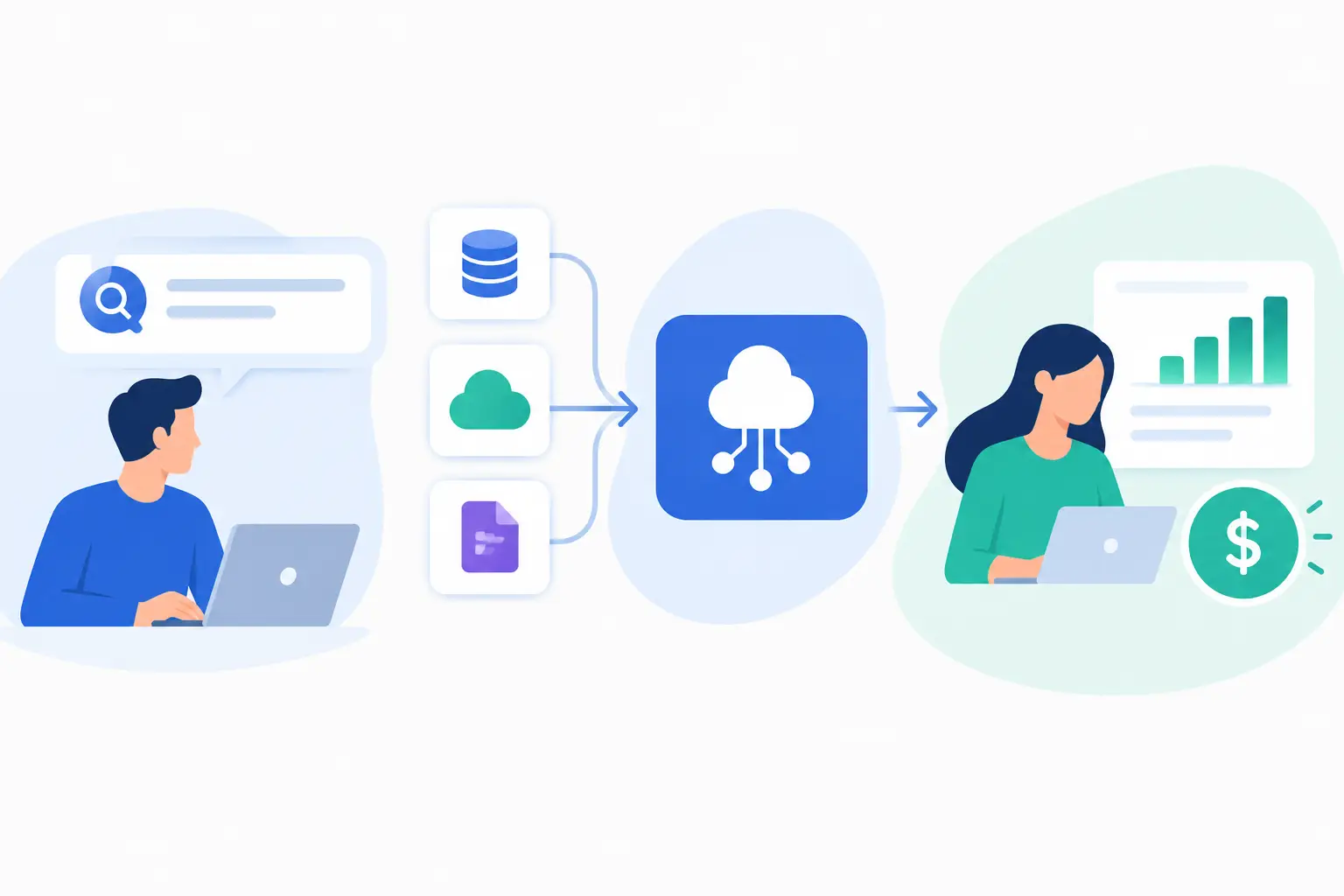
A useful API vendor monetization example starts with a decision a customer is already trying to make. A consultant needs to identify suppliers that won public contracts. An investor wants to compare a company’s filings over time. A product team needs verified business details inside its own workflow. The API is not the product in isolation. The product is faster, more defensible work built on data the buyer could not easily collect, standardize, and maintain alone.
That distinction changes how an API vendor should price, package, and measure its service. Charging for raw requests can be appropriate, but only when it aligns with the value delivered and the underlying cost of providing the data.
An API vendor monetization example in practice
Consider a vendor that provides searchable public-contract records and company information through an API. Its customers include market intelligence teams, procurement consultants, and software developers building research tools. The vendor collects data from available public sources, maps inconsistent supplier names to business entities, and makes records accessible through a consistent query interface.
The first temptation is a single price per API call. It is simple to explain: 10,000 calls cost one amount, and additional calls cost another. But this model can create two problems. A buyer making one high-value decision may use very few calls, while a customer running broad searches may create substantial infrastructure and source-processing costs. Neither situation is well represented by request volume alone.
A better model combines access with usage. For example, the vendor could offer a monthly platform plan that includes search, documentation, support, and a defined usage allowance. Higher tiers can add more records returned, higher rate limits, additional source collections, or commercial reuse rights where those rights are available. Usage beyond the allowance is charged at a published rate.
This gives customers a predictable starting cost while letting the vendor recover costs as adoption grows. It also makes the buying decision clearer. A research firm can choose a plan based on the number of projects it runs. A developer can choose based on expected application traffic. Neither has to guess whether a single exploratory query will produce an unreasonable bill.
Price the outcome, not just the endpoint
Not every endpoint deserves the same price. An endpoint that returns a basic company name may be inexpensive to operate and easy for customers to replace. An endpoint that returns a normalized entity profile, linked contract history, source references, and update dates may save hours of manual research. The latter supports a higher price because it does more work for the customer.
The pricing unit should reflect that difference. A vendor might charge per record returned for broad discovery searches, per enriched company profile for detailed due diligence, and per monitored entity for ongoing alerts. These are distinct jobs with distinct value.
Take a business development team researching public-sector opportunities. A broad search across contract notices is useful for finding a market. Detailed supplier and buyer profiles help qualify targets. Monitoring newly published notices helps the team act quickly. Packaging all three as identical API calls hides the value of the workflow. Packaging them as discovery, enrichment, and monitoring makes the commercial logic easier to understand.
There is a trade-off. More pricing units can reflect value more accurately, but too many units make invoices difficult to forecast. Keep the model understandable enough that a customer can estimate a month of use without a spreadsheet. Three well-defined meters are usually easier to sell and operate than seven highly specific ones.
Build plans around real buyer stages
API pricing works best when plans match how customers adopt data. Most buyers begin with validation. They want to check coverage for a set of companies, test matching quality for their use case, and confirm that the data fits their application or research method. A limited trial, sample access, or low-commitment starter plan can support that stage.
The next stage is repeatable use. A consultant may run the same market screen every month. A sales operations team may enrich a defined account list. A software team may put the API behind a feature used by its customers. At this point, the vendor should offer predictable monthly access with documented limits.
The final stage is operational dependency. The customer may need larger volumes, higher throughput, a stable data extract, custom onboarding, or contractual terms for a specific use case. This is where an enterprise plan makes sense. It should not merely be a larger call allowance. It should address the operational needs that a production customer actually has, such as clear support expectations, access controls, and a defined approach to source changes.
For a data platform with European coverage, this may also mean separating plans by source availability. A buyer working with Dutch public records may have different needs from a buyer using broader commercial datasets. Be precise about what each collection covers, how often it is refreshed when known, and what it does not contain. Coverage clarity prevents revenue from turning into churn.
Protect the economics behind the API
Revenue is only useful if the service remains economical to provide. Data vendors carry costs that customers do not see: source access conditions, collection and processing, normalization, storage, query infrastructure, monitoring, and support. A cheap unlimited plan can become expensive quickly when a customer uses the API for bulk extraction or repeatedly runs poorly designed queries.
Rate limits and usage caps are not punishments. They are part of a fair commercial agreement. State them plainly, show customers how to monitor their use, and provide an upgrade path before a limit becomes a disruption. A customer who understands why an allowance exists is more likely to plan around it.
Commercial rights need equal care. Some data can be used for internal research but not redistributed in a customer-facing product. Some sources may permit access only under conditions that affect how data is stored or displayed. Do not bury those limits in vague terms. Explain them during evaluation, especially when the buyer is building an application or an AI-assisted workflow.
A reliable vendor also avoids implying more than the source supports. Public records can be delayed, incomplete, amended, or structured differently across jurisdictions. Entity matching can be strong without being perfect. Showing source references, dates, and coverage boundaries helps customers decide when data is sufficient for a decision and when they should perform additional verification.
Make usage visible before the invoice arrives
The best monetization model still fails if customers cannot understand their consumption. Give them a dashboard or clear reporting that shows requests, records returned, current plan allowance, and projected overage. If different endpoints use different meters, show each one separately.
This is especially valuable for teams building automated workflows. A developer may deploy a new feature that turns a modest test workload into thousands of daily queries. Early visibility lets the team adjust caching, query design, or its plan before costs become a surprise. It also gives the vendor a useful sales signal: sustained growth is an opportunity to discuss a better-fit tier, not just send a larger bill.
The same principle applies to trials. A trial should reveal whether the customer can get useful results, not merely whether they can send requests successfully. Good documentation, representative examples, and clear source descriptions do more for conversion than a large but confusing free quota.
What this model gets right
This API vendor monetization example works because it connects price to a customer’s job, rather than treating every request as equal. It leaves room for low-friction evaluation, creates a predictable path to repeat use, and recognizes that production customers need more than volume. It also respects the limits of the underlying data and the cost of maintaining it.
The exact mix depends on the product. A real-time application may need rate-based pricing. A research database may be better priced by seats, exports, or records. A platform offering natural-language requests alongside APIs may need to meter both queries and the underlying data retrieved. The right answer comes from observing which actions create customer value and which actions create meaningful cost.
Before setting a public price, test the model with a handful of real buyer scenarios. Ask what decision they are making, how often they need the data, and what they would do without it. The answers will usually point to a pricing model that customers can explain internally and a business that can keep serving them well.