
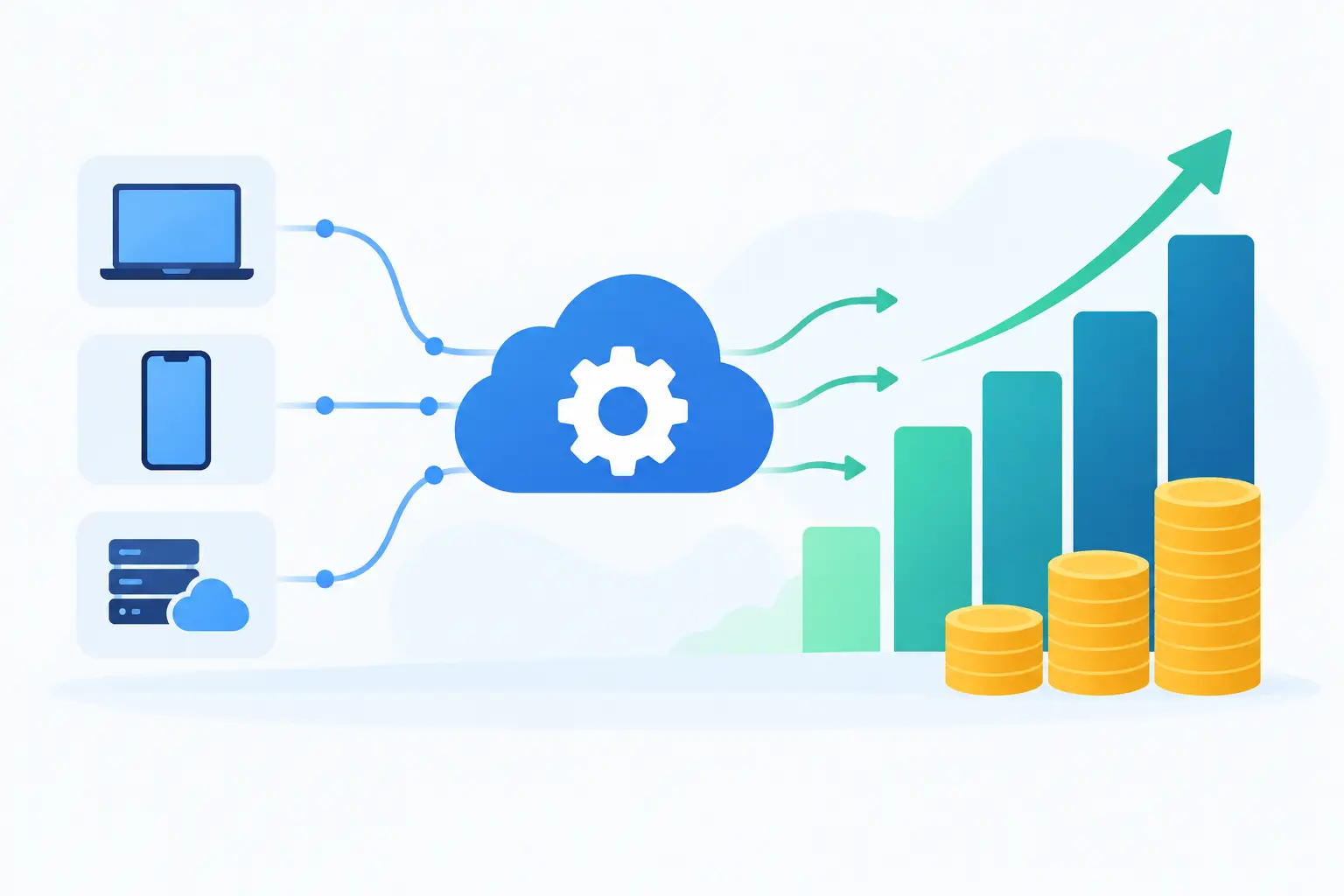
An API can receive thousands of requests before anyone asks a basic commercial question: who is paying for this, at what price, and how does the money reach the business? API revenue automation closes that gap. It turns each request, dataset pull, model call, or agent task into a governed commercial event - with pricing, authorization, access, settlement, and records connected from the start.
For API providers, this is not just a billing upgrade. It is the operating model required when customers are software, AI agents, and autonomous workflows that cannot wait for a sales call, a purchase order, or an invoice at the end of the month.
API Revenue Automation Is a Commercial Control Plane
Traditional API monetization often splits the customer experience in two. Developers get an API key and documentation. Finance gets invoices, usage exports, and exceptions later. That works when contracts are large, buyers are human, and consumption is predictable enough to reconcile after the fact.
It breaks down when access needs to be purchased programmatically. An agent may need a single premium lookup, a short burst of compute, or access to a specialized dataset for one workflow. It needs to know the price, prove it can pay, receive the entitlement, and continue its task without switching to a procurement portal.
Revenue automation makes the commercial layer part of the API itself. Instead of treating payment as an administrative process around usage, it treats payment, policy, and access as a coordinated system.
That distinction matters. A metering tool can tell you what happened. An invoicing platform can ask for payment after it happened. A revenue automation layer decides whether a request is allowed, what it costs, how payment is collected, and how the transaction is recorded while the request is happening.
Why Usage Billing Alone Is Not Enough
Usage-based pricing is a strong starting point, but a price per request does not create a usable revenue system on its own. Providers still need to resolve four questions: what is being sold, who can buy it, when access is granted, and how the proceeds are settled.
Consider a data API charging per record returned. A human customer might accept a monthly bill with a spending cap. An AI agent cannot. It needs a machine-readable price, an approved payment method, a clear response when funds are insufficient, and a way to retry or select a lower-cost option. If those rules sit outside the request path, the provider has created a manual dependency in what should be an automated transaction.
The same issue appears with credits. Credits can simplify internal accounting, but they create friction if buyers must pre-fund a closed balance before trying a service. They also hide the underlying cost from agents deciding among multiple providers. For high-frequency, known workloads, prepaid balances can be efficient. For discovery-driven or occasional agent activity, direct, request-level payment can be a better fit.
The right model depends on the product. The goal is not to force every API into micropayments. The goal is to make every commercial path enforceable by software.
The Architecture Behind Automated API Revenue
A production-grade system joins technical controls to financial controls. It should be able to price an interaction before execution, collect or authorize payment, grant the correct level of access, and produce a record that operations and finance can trust.
Product catalog and price logic
Start by defining the sellable unit. It may be an API call, a token, a document processed, a successful result, a compute second, or a premium workflow. The unit should map to value delivered, not merely what is easiest to count.
Pricing logic must also be explicit. Different endpoints may carry different prices. A search result may be inexpensive, while enriched data, historical coverage, or guaranteed latency commands more. Volume tiers, geographic rules, customer-specific agreements, and rate limits should be policies in the system, not spreadsheet exceptions maintained by someone on the finance team.
Simple pricing wins early. But simplicity should not mean inflexibility. Providers need room to introduce premium tiers or revise margins without rebuilding their access layer.
Metering and event integrity
Every billable event needs a durable identity. Record who made the request, what product was consumed, what price applied, whether the request succeeded, and what entitlement was checked. That event trail protects both sides when a customer disputes usage or an internal team needs to investigate an anomaly.
Meter after the business outcome is known whenever possible. Charging for a request that fails before producing the promised output creates support costs and erodes trust. There are exceptions: reserved capacity, expensive pre-processing, and long-running compute may justify charges at initiation or in stages. The charging point should reflect the economics of the service.
Payment authorization and access enforcement
Payment and access cannot be separate concerns. If a customer is out of funds, exceeds a budget, or lacks permission for a premium endpoint, the API should return a clear machine-readable response. An agent can then retry with an approved payment, select a cheaper service, or stop the task.
This is where payment-aware protocols such as x402 matter. They make payment requirements visible in the request-response flow rather than burying them in a dashboard. For providers, that means fewer custom checkout flows. For agent builders, it means APIs can be discovered and purchased as part of an automated workflow.
Still, request-level payment is not the answer to every workload. High-volume traffic can create extra payment events and operational overhead. A practical platform supports more than one commercial path: subscriptions for predictable access, prepaid accounts for controlled spend, and pay-per-use for immediate programmatic purchases.
Settlement, accounting, and operational continuity
Collecting funds is only half the job. Businesses need usable money, predictable settlement, and records that fit their accounting process. If an API accepts machine-native payments but finance receives an unclear transaction trail or has to manage volatile assets manually, the commercial benefit disappears.
A mature flow connects payment acceptance to conversion, settlement, reconciliation, refunds, and reporting. It should preserve enough transaction detail to explain revenue by product, customer, agent, and time period. This is what makes automated payments commercially credible inside a real business.
For companies selling globally, currency handling and regional compliance can change the design. The best approach is often to keep the buyer experience programmatic while giving the provider a settlement path that matches its operating currency and bookkeeping requirements.
Designing for AI Agents Changes the Buyer Journey
AI agents do not browse pricing pages the way people do. They evaluate capabilities, constraints, costs, and response formats as inputs to a task. An API that is technically excellent but commercially ambiguous is hard for an agent to use reliably.
Make the offer legible to software. State what the endpoint does, the unit of charge, the price, the payment requirement, and the response expected after payment. Return errors that distinguish authentication failure from insufficient payment, rate limits, and unavailable inventory. Those details reduce wasted calls and let builders create reliable fallback logic.
Budget controls are equally important. Agent autonomy without spending policy is not a business feature. Let customers set limits by agent, project, endpoint, time window, or transaction. A procurement team may approve a daily research budget while forbidding premium data purchases above a certain amount. The API should enforce that policy automatically, not rely on a human noticing a report later.
Providers benefit from the same visibility. They can identify which endpoints agents buy repeatedly, where payment failures occur, and whether a price point blocks conversion. That feedback is far more useful than a monthly usage total because it exposes the commercial behavior inside the request stream.
Where Teams Get Stuck
The first mistake is treating monetization as a final integration after the API is built. By then, pricing identifiers, entitlement rules, and usage events are often inconsistent across services. Retrofitting them is possible, but it is slower and more error-prone.
The second is building too much payment logic in-house. Custom ledgers, wallets, refund systems, tax workflows, and settlement processes can absorb a team that should be improving its core product. Build the pieces that differentiate the API. Use infrastructure for the repeated financial work.
The third is optimizing only for conversion. Frictionless payment matters, but so do fraud controls, auditability, customer support, and clear refunds. A system that accepts every transaction but cannot explain or reverse it creates a different kind of friction later.
Apiosk approaches this as API-native commercial infrastructure: payment in the request flow, controlled access, and settlement designed for real business operations. The value is not another payment button. It is a revenue path that software can execute and finance can operate.
Start With One Paid Interaction
Do not begin by redesigning every plan and contract. Choose one endpoint or workflow where the value is easy to define and demand is already visible. Set a clear unit price, attach a payment and access rule, capture complete events, and decide how successful payments settle into the business.
Then test the experience from an agent builder's perspective. Can software understand the price before it commits? Can it pay without human intervention? Does it receive a useful response when payment fails? Can your operations team trace the resulting revenue without reconstructing it from logs?
The providers that answer yes will not just monetize API traffic. They will be ready when buying software becomes as normal as calling software.