
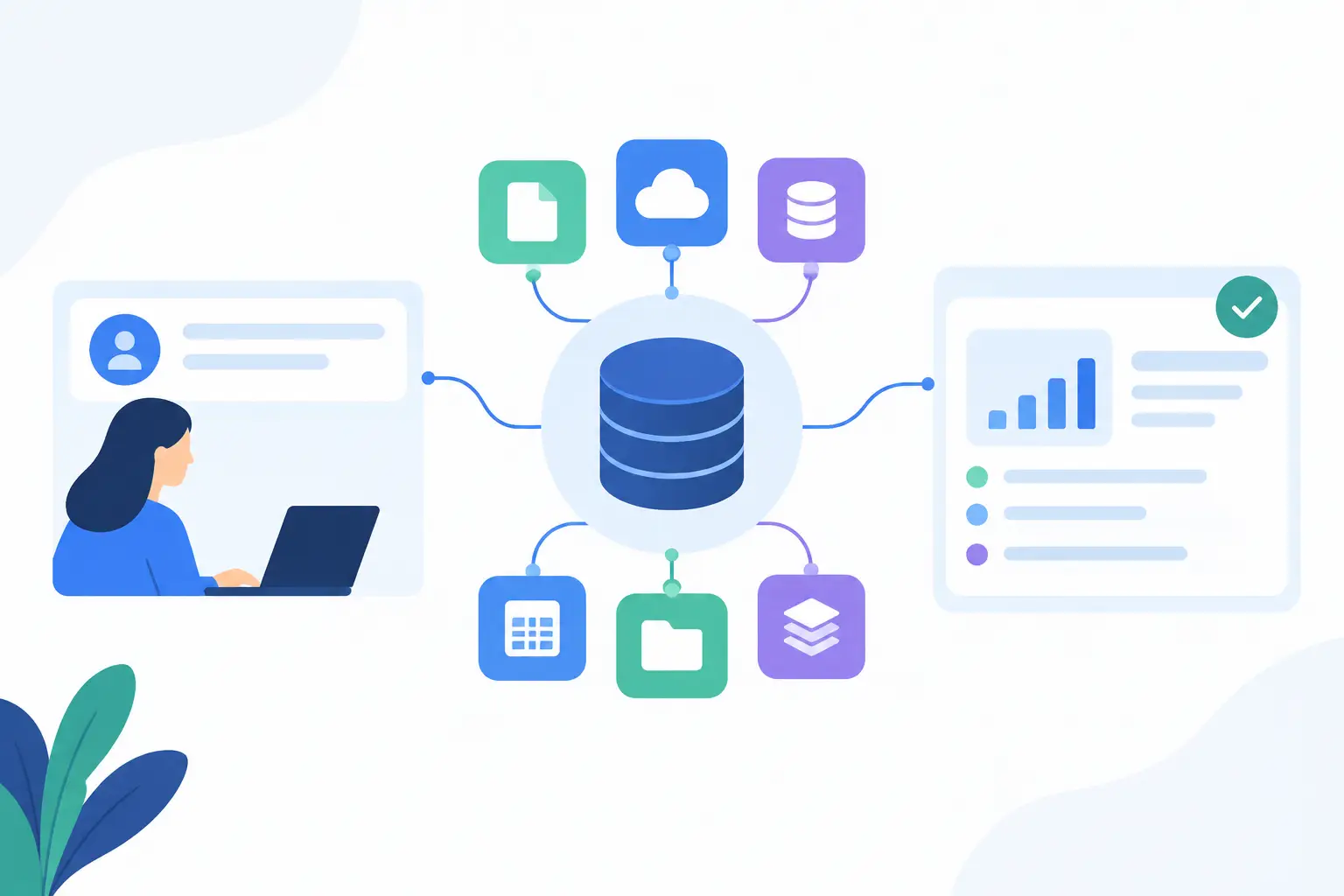
An AI agent can draft a market brief in minutes. The harder question is whether it can retrieve the right company record, distinguish a live public contract from an expired one, and show where each answer came from. AI agent protocols are the connection layer that makes those actions possible. They give agents a defined way to discover tools, request data, and return results that another system can use.
For teams building research workflows, sales intelligence products, internal copilots, or automated due diligence, this matters because the model is only one part of the system. The value comes from what the agent can actually do with reliable data under clear permissions.
What AI agent protocols actually do
An AI agent protocol is a shared set of rules for communication between an agent and an external capability. That capability may be a database, a search service, a document store, a CRM, or a specialized data API.
Without a protocol, every integration is custom. A developer has to tell the agent what tools exist, what inputs they accept, how errors appear, and what a successful response looks like. With a protocol, those details can be exposed in a structured, reusable form. The agent can inspect available tools, select one, provide the required parameters, and process the output.
The best-known example is the Model Context Protocol, often called MCP. It provides a common pattern for exposing tools, resources, and prompts to AI applications. Other approaches focus on agent-to-agent communication, where one specialized agent delegates work to another. Both solve a real problem: agents need a dependable way to interact with systems beyond the language model.
The protocol does not make the underlying information better. It does not verify a company name, expand source coverage, or resolve conflicting records. It standardizes the handoff between the agent and the system that can perform those tasks.
Why the protocol is only half the decision
Protocol support is useful, but it is easy to overvalue. A polished integration can still return stale, incomplete, poorly scoped, or poorly documented data. For business use, the more important questions are practical.
What sources are available? What fields can the agent retrieve? Does the result include a source reference, publication date, and jurisdiction where relevant? Can you limit the agent to approved datasets or actions? What does a query cost, and what happens when the data source has no answer?
Consider a consultant researching a European software vendor. An agent may need to search the legal entity, review public procurement awards, identify directors where available from the source, and flag gaps before preparing a short brief. A protocol can let the agent call each relevant tool. But the quality of the brief still depends on entity matching, source coverage, refresh timing, and the ability to show the evidence behind each claim.
This is why a data integration should be evaluated as a product, not just a protocol badge. The connection method matters. The data contract matters more.
How AI agent protocols change data workflows
Traditional APIs expect a developer to write the sequence of calls in advance. That remains the right choice for stable, high-volume workflows such as nightly enrichment, production dashboards, or a fixed onboarding check.
Agents add value when the sequence is variable. A user can ask, “Which Dutch construction companies won public contracts in this category last year, and which appear to be growing?” The agent may need to clarify the category, search contract notices, identify organizations, retrieve company information, and explain the limits of the available records.
A protocol gives the agent a controlled path to do that work. Rather than receiving unrestricted access to a broad system, it can be offered a small set of named tools with explicit inputs and outputs. For example, one tool may search companies by name and country. Another may retrieve public contract notices by buyer, supplier, date range, or classification. A third may return source details for a record already found.
That structure has two business benefits. First, it makes natural-language access more useful because the agent can turn a question into a series of data requests. Second, it makes the workflow easier to audit because each tool call can be recorded, reviewed, and constrained.
Apiosk can fit into this pattern by making covered business and public-source data accessible through natural-language requests, APIs, and AI integrations. Coverage depends on the specific source, so a useful agent should state what it searched and where evidence is unavailable rather than filling gaps with assumptions.
Where protocols help most
AI agent protocols are especially effective when people ask recurring questions that still require judgment about the next step. Research, procurement monitoring, account planning, market mapping, and investment screening are common examples.
A founder might ask for competitors in a target segment and then request a list filtered by geography, legal status, or public-sector activity. A business development team might investigate an account, then ask whether related entities have appeared in recent contract awards. An analyst might start with a company name and work outward to relevant public records, ownership information, or market signals available through connected sources.
The protocol does not replace a data model. It exposes the data model in a form an agent can use. That distinction is useful when setting expectations with stakeholders. Natural-language requests can reduce the time spent navigating systems, but they do not remove ambiguity from the underlying question.
“Find the top suppliers” still requires a definition of top. Revenue, contract value, employee count, number of awards, and geographic reach can all produce different answers. A well-designed agent should ask for clarification when needed or state the interpretation it used.
The controls that make agent access usable
Giving an agent access to business data should not mean giving it unlimited authority. Start with read-only queries where possible. Keep write actions, such as changing CRM fields or sending messages, separate from research tools and subject to confirmation.
Good implementations make four things explicit:
- Tool scope: Define exactly what each tool can search, retrieve, or change.
- Input rules: Use validated fields for dates, identifiers, jurisdictions, and result limits instead of relying entirely on free text.
- Source context: Return source names, record dates, and coverage notes alongside the result whenever the source provides them.
- Cost and rate limits: Set query budgets and result caps so exploratory agent behavior does not create surprise usage.
Logging is equally important. When an agent produces a recommendation, a user should be able to see the sequence of data requests that supported it. This is not only a governance concern. It is how researchers catch an incorrect entity match, an overly broad filter, or a result that is old enough to change the decision.
Choosing between MCP, direct APIs, and custom workflows
There is no single best integration method. MCP-style access is a strong fit when your users work inside AI clients or when you want an agent to discover a set of data tools dynamically. It speeds up experimentation and reduces the work of building a one-off connector for every agent environment.
Direct APIs are better when the workflow is known, repeatable, and performance-sensitive. If your product needs to enrich 50,000 records on a schedule, application code should manage the job directly. The logic is easier to test, costs are more predictable, and the result does not depend on an agent choosing the right sequence of tools.
A hybrid approach often works best. Use APIs for the operational backbone: scheduled data collection, normalized records, alerts, and product features. Use an agent protocol for the human-facing layer, where people need to ask follow-up questions, explore a market, and inspect the evidence before acting.
Build for answers that can be checked
The most useful AI agent is not the one that sounds most certain. It is the one that turns a business question into a traceable research path: identify the entity, search the relevant sources, apply the requested filters, return the records, and make uncertainty visible.
That is the practical promise of AI agent protocols. They make data services easier for agents to use. The teams that get real value from them will pair that convenience with narrow tool design, clear source context, and a simple rule for every high-stakes output: make it possible for a person to check the answer before they rely on it.