
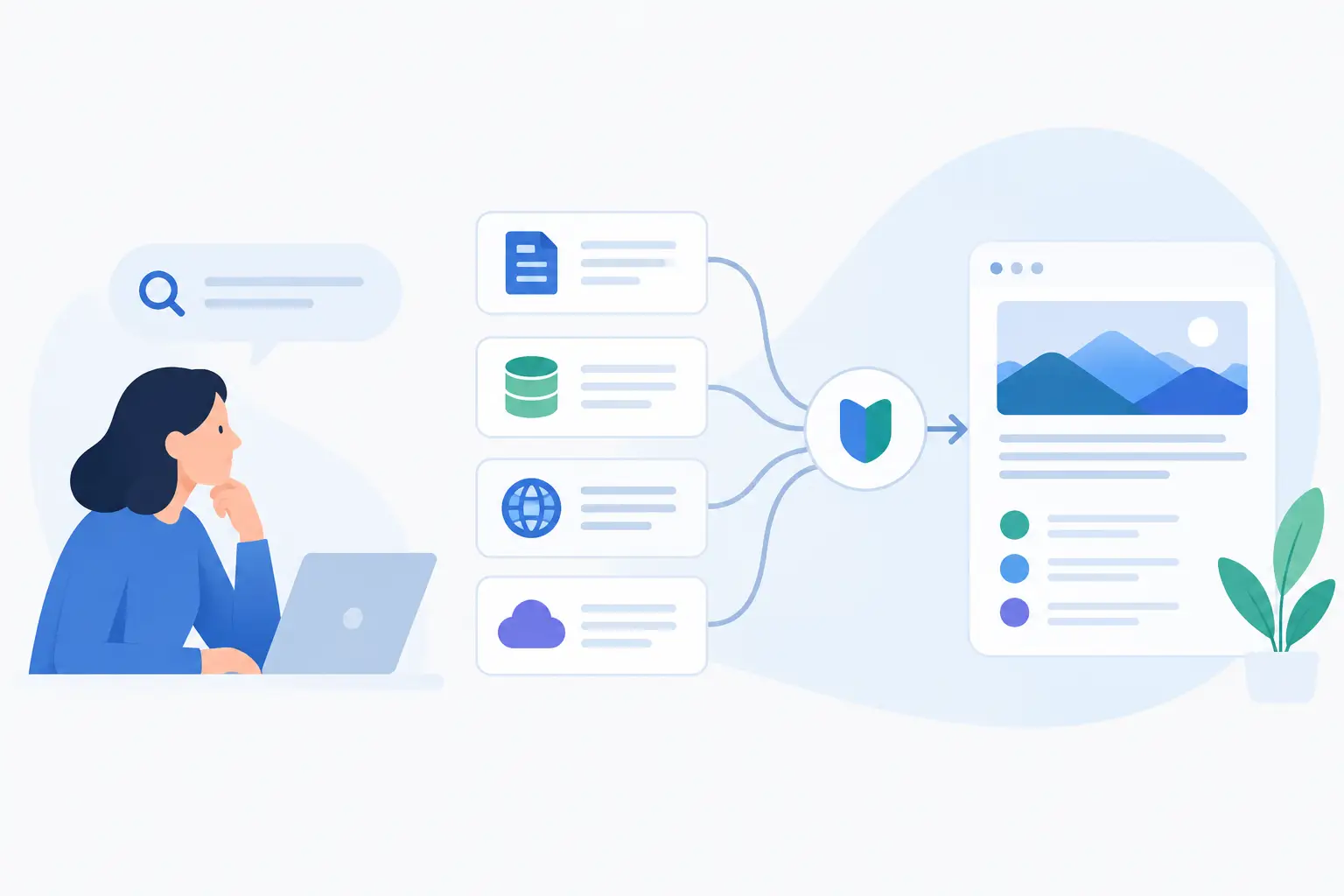
An agent that can draft an email is easy to demo. An agent that can identify a company, verify its legal entity, retrieve a relevant public contract, explain where each fact came from, and ask for approval before acting is a business system. That gap is defining the most useful AI agent infrastructure trends.
For founders and teams building research, sales, procurement, compliance, or market-intelligence workflows, the model is only one layer. The harder work is giving an agent controlled access to current information, clear operating boundaries, and a way to prove what happened after the task is complete.
AI Agent Infrastructure Trends Are Moving Beyond the Model
The early agent conversation focused heavily on reasoning models and autonomous task completion. Those capabilities still matter, but they are not what usually limits a production workflow. The limits are data access, permissions, reliability, latency, cost control, and review.
A useful agent needs to know which sources it may query, what each source covers, how fresh the returned information is, and when a result is too uncertain to use. If it is researching a supplier, for example, it may need company registration details, public procurement records, sanctions-related sources where appropriate, and the customer’s own internal notes. Treating all of that as one undifferentiated knowledge pool creates risk.
The infrastructure layer is becoming the place where those decisions are made. It connects models to tools and sources, records the context behind an answer, applies policy, and routes work to a person when the task crosses a meaningful threshold.
Governed Data Access Becomes a Core Feature
Agents are only as useful as the information they can retrieve. A general web search may help generate leads, but it is a weak foundation for a decision that affects a contract, investment memo, or vendor shortlist. Business teams need defined sources, known coverage, and outputs that can be checked.
This is driving a move from broad retrieval toward governed data access. Rather than giving an agent open-ended permission to search everywhere, teams are exposing specific tools with specific purposes. One tool might search company records. Another might retrieve public tenders. A third might query an internal customer database. Each tool can return structured fields alongside source references, dates, and coverage notes.
This design makes an agent more useful because it narrows the task. A request such as, “Find Dutch software companies that recently won public contracts and appear to be expanding into Germany,” can be broken into traceable steps. The agent can search available company and contract sources, state which geographies and dates were searched, and distinguish a verified fact from an inference.
For data providers, this changes the product requirement. An API is no longer only serving a dashboard or a developer script. It is being called by software that must select the right endpoint, interpret the response, and explain the result to a user. Clear schemas, predictable filters, source metadata, and meaningful error messages matter more than clever prompts.
Apiosk fits this pattern by making available government and commercial data accessible through natural-language requests, APIs, and AI integrations. The practical value is not a vague claim of knowing everything. It is giving teams a defined route to the sources available for a particular question.
Source provenance is part of the answer
An agent should not simply say that a company won a contract or operates in a market. It should preserve the supporting record: source name, retrieval date, relevant identifier, and any caveat about coverage. This is especially important when records are updated, names are similar, or a data source has regional limits.
Provenance does not guarantee that every record is correct. It gives the user enough context to assess a claim and investigate it. That is a much better standard for business use than an answer that sounds confident but cannot be traced.
Tool Calling Is Replacing One Giant Prompt
The strongest agent workflows are increasingly composed of smaller, explicit actions. The model decides whether to call a search tool, a database query, a document parser, or a calculation function. The infrastructure validates the request and returns data in a format the agent can use.
This is less glamorous than a fully autonomous assistant, but it is easier to operate. A procurement-research agent does not need unrestricted browsing and write access to business systems. It needs a reliable sequence: identify the company, retrieve relevant contracts, compare dates and values, flag missing details, and prepare a reviewable brief.
Structured tool calls also make failures easier to isolate. If the company-match step returns multiple entities, the workflow can ask a clarifying question instead of continuing with a guess. If a source is temporarily unavailable, the agent can report the gap rather than inventing a conclusion.
The trade-off is more engineering upfront. Teams must define tools, input rules, error handling, and permissions. In return, they get workflows that are easier to test, improve, and trust.
Observability Shifts From Technical Nice-to-Have to Business Control
When an agent produces a bad result, “the AI got it wrong” is not an actionable diagnosis. Teams need to know which model was used, which tools were called, what data was returned, how long each step took, what the workflow cost, and whether a human changed the final output.
Agent observability is therefore becoming a standard operating requirement. A trace should show the path from user request to final answer without exposing sensitive information to everyone who can view logs. For a research workflow, that may include the search query, returned records, entity-match decision, source timestamps, and final citations. For an action workflow, it should also record approvals and the exact change made.
This visibility helps with more than debugging. It reveals where the business process is weak. Perhaps agents spend too much time resolving company names. Perhaps a valuable source is frequently missing a key field. Perhaps users accept summaries but regularly correct market classifications. Those signals can guide better data acquisition and workflow design.
Human Review Is Becoming More Targeted
The choice is not between full automation and a human checking every sentence. Good infrastructure lets teams apply review where the risk is highest.
An agent can usually handle low-risk work such as compiling a first-pass list of companies, extracting fields from public documents, or preparing a research brief. It should escalate when it encounters ambiguous entity matches, conflicting sources, sensitive decisions, or actions that affect customers, contracts, or money.
Approval rules should be concrete. For example, require review when the agent cannot match an organization to a unique identifier, when a source is older than a defined threshold, or when a recommended action is based on fewer than two relevant records. These rules are easier to defend than asking a model to decide whether it feels confident.
Cost and Latency Are Becoming Product Decisions
Agent costs are not limited to model tokens. They include tool calls, data licensing, document processing, storage, monitoring, and human review. A workflow that makes ten broad searches to answer a simple question may look capable while delivering poor unit economics.
The practical trend is toward routing. Use a lower-cost model for classification, extraction, and simple transformations. Reserve more capable models for synthesis or ambiguous reasoning. Cache stable results where permitted, but refresh information that changes frequently. Ask targeted follow-up questions instead of launching expensive research paths from an underspecified request.
Data pricing also needs to be visible in the design. Some sources are free to access but difficult to normalize. Others carry usage or licensing costs. The right choice depends on the value of the decision, how often the workflow runs, and whether a user needs evidence they can inspect. Cheap data that cannot answer the question is not a saving.
What to Build First
Teams do not need a general-purpose autonomous agent to benefit from this shift. Start with a bounded job where the output has a clear user, a defined decision, and a known set of data sources. Market mapping, company enrichment, public-contract monitoring, and investment research preparation are good examples.
Define the expected output before selecting a model. Specify the fields required, the sources the agent may use, the acceptable time range, the escalation conditions, and how the result will be reviewed. Then measure whether the workflow reduces research time without lowering the standard of evidence.
The durable advantage will not come from giving an agent more freedom than anyone else. It will come from making useful information available in a controlled, inspectable form. Build agents that can show their work, acknowledge their limits, and hand the right decision to the right person.