
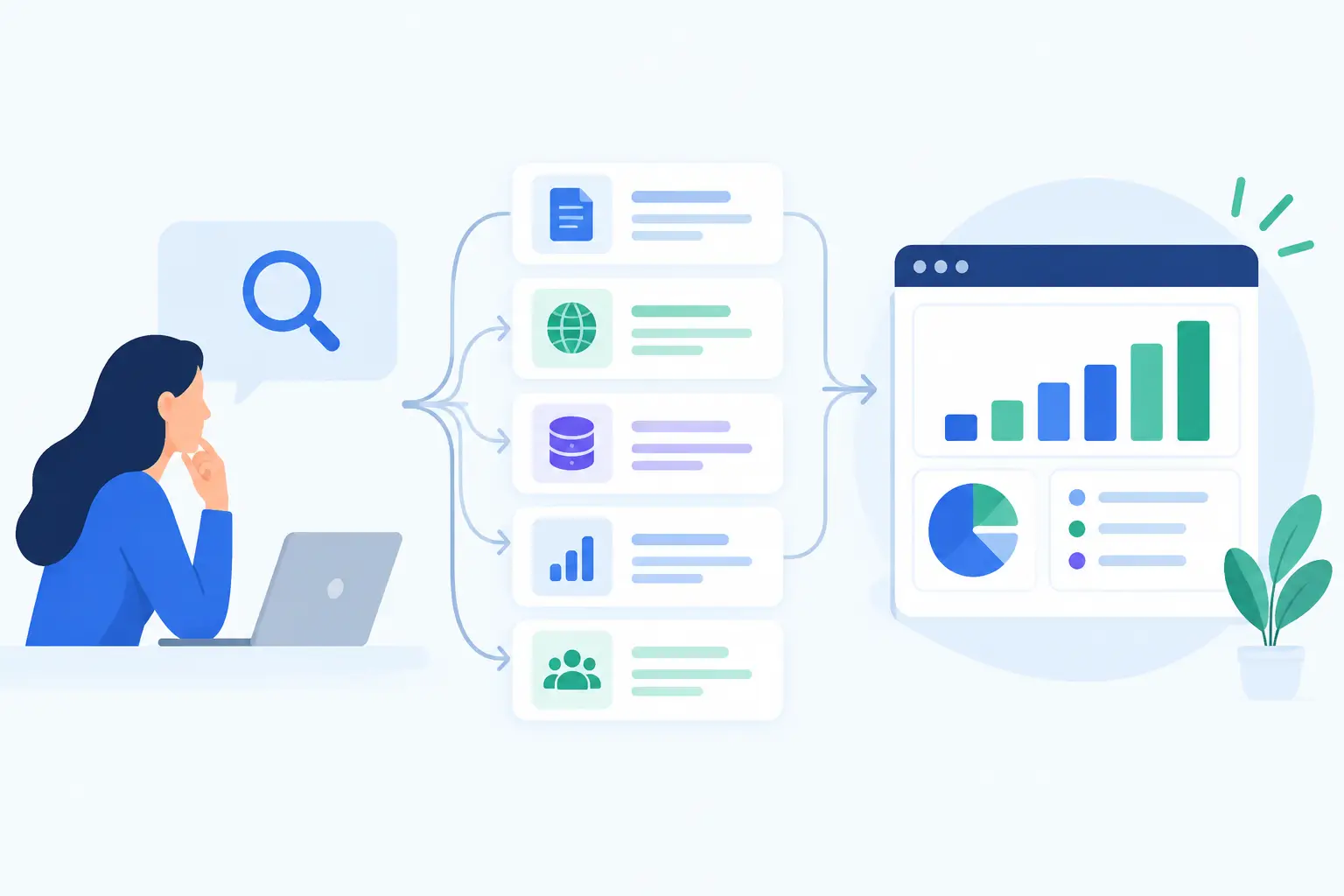
A researcher asks an agent to identify fast-growing suppliers in a market, check whether they have won public contracts, and flag leadership changes. The useful result is not a polished paragraph. It is a set of answers tied to named sources, clear dates, and enough context to decide what to do next.
That is the practical center of agent data trends. AI agents are changing how teams request, combine, and act on business information. But the value does not come from asking better questions alone. It comes from giving agents controlled access to relevant data, defining what evidence is required, and keeping the output reviewable.
For founders, investors, consultants, researchers, and product teams, this shifts data work from a sequence of searches into a repeatable operating process. The opportunity is real. So are the limits.
Agent Data Trends Are Moving From Search to Workflows
Traditional business research often starts with a browser, a spreadsheet, and a loosely defined question. A team member searches company pages, registries, procurement portals, news coverage, and internal documents. They reconcile conflicting names, check dates, and eventually produce a brief. That process can be thoughtful, but it is difficult to repeat at speed.
Agents can compress the administrative part of that workflow. They can take a request in plain language, retrieve available records, normalize company names, compare fields, and return an answer in a consistent format. A sales operations team might ask for companies in a specified region and sector that meet a size threshold. A consultant might ask which suppliers appear in contract award data over a given period. A product team might enrich a user-submitted company list before routing accounts.
The trend is not that agents replace judgment. It is that they can handle more of the repeatable evidence-gathering work before a person makes the judgment call.
That distinction matters. “Find the best acquisition target” is not a data request an agent can settle on its own. “List companies that match these stated criteria, show the source and date for each field, and identify missing records” is a much better task. The second request produces a reviewable starting point. The first risks hiding subjective decisions behind confident language.
The Data Layer Is Becoming the Product Decision
A capable agent connected to weak, unclear, or poorly matched data will still produce weak decisions. This is why the most consequential agent data trends are less about chat interfaces and more about data access.
Teams increasingly need to ask four direct questions before they connect data to an agent: What is the source? What geography and time period does it cover? How current is it? What does the source not show?
Those questions are especially relevant for company, market, and public-sector research. A commercial dataset may have strong coverage for a particular industry but limited detail for smaller firms. A government register may be authoritative for legal entity information, while being less useful for current operating signals. Public contract data can reveal awards and buyers, but the fields and publication timing vary by authority.
The right source depends on the decision. If you are validating a legal company identity, official registry data may be the appropriate foundation. If you are mapping competitive activity, you may need a combination of structured company records, procurement notices, and public web information. If you are prioritizing accounts, a narrower dataset with fields that match your ideal customer profile may be more useful than a broad database with inconsistent coverage.
This is also where natural-language access can help without making the underlying system opaque. A person should be able to ask for relevant records in ordinary language. The resulting workflow should still expose the filters used, source context, and any assumptions made during matching.
Retrieval matters more than a fluent answer
An agent can write a convincing explanation even when the evidence is incomplete. Business workflows need a different standard: retrieve first, reason second.
For a company lookup, that means returning the matching entity, available identifiers, location, status, and source details before generating a narrative. For contract research, it means distinguishing an award notice from an opportunity notice, showing the awarding organization, value when published, date, and supplier name as recorded. For market analysis, it means separating observed data from an interpretation of that data.
This approach makes errors easier to spot. It also makes results reusable. A researcher can export the records, a developer can pass them to an internal tool, and an AI workflow can apply the same criteria again next week.
The Most Useful Agent Work Is Narrow and Repeatable
The strongest early use cases are not broad autonomous projects. They are bounded jobs with clear inputs, sources, and outputs.
Consider a consulting team preparing for a client meeting. Instead of assigning someone to gather basic company information from several places, they can run a defined brief: confirm legal entities, find related companies where available, identify recent relevant public contracts, and mark fields that require manual verification. The consultant spends time on the recommendation, not on copying facts between tabs.
Or consider a founder evaluating a new market. An agent can help create a first-pass list of companies that match geography, industry, and stated signals. It can identify public procurement activity that suggests demand patterns. It cannot tell the founder whether the market is attractive without a business model, pricing assumptions, customer conversations, and human judgment.
Developers have a related opportunity. Rather than building a large data pipeline before testing demand, they can integrate specific data retrieval capabilities into their application or agent workflow. An API is often the better fit when structured fields need to feed product logic. Natural-language requests are useful when internal users need ad hoc research. AI integrations work best when the agent has strict instructions about allowed sources, output format, and escalation when evidence is missing.
Apiosk is built around that model: request available government and commercial data in natural language, through APIs, or inside AI workflows. The practical benefit is not merely faster access. It is giving teams one clearer route from a business question to source-aware information.
What Changes for Data Teams and Buyers
Agent adoption changes the economics of research. The cost is no longer only a database subscription or an analyst’s time. Teams need to account for data access charges, API usage where applicable, implementation effort, review time, and the cost of a bad decision based on mismatched data.
For low-stakes discovery, lighter review may be enough. For investment screening, compliance-sensitive work, contract decisions, or customer-facing outputs, review requirements should be higher. The more material the decision, the more important it is to retain source references and timestamps.
Buyers should also resist the temptation to measure value by the number of records returned. A smaller set of relevant, explainable results can be worth more than millions of generic profiles. The useful metric is whether the data helps a team reach a decision faster with fewer avoidable errors.
This favors systems that make uncertainty visible. A missing field should remain missing. A weak entity match should be labeled as a possible match, not presented as fact. A source with limited geographic coverage should not be treated as a global view. These details may feel less polished than a single definitive answer, but they are what make agent-supported research dependable.
How to Build an Agent Data Workflow That Holds Up
Start with one decision that happens frequently. It might be qualifying inbound companies, researching prospective partners, monitoring contract awards, or preparing market briefs. Define the output before choosing the agent: which fields matter, which sources are acceptable, what date range applies, and what requires human review.
Then test the workflow on known cases. If the agent cannot correctly retrieve and explain information for companies or contracts you already understand, it is not ready for higher-stakes use. Test ambiguous names, missing identifiers, cross-border entities, outdated records, and requests outside the source’s coverage. Those cases reveal whether the workflow is genuinely useful or simply persuasive.
Finally, make the handoff explicit. An agent should know when to return a result, when to ask for clarification, and when to say that the available data cannot support the request. That last behavior is a feature, not a failure.
The next step for business research is not handing every question to an agent. It is designing a few high-value questions that agents can answer with traceable evidence, then letting people use that evidence to make better calls.